





The consequences of unreliable equipment ripple through every aspect of an industrial business. From product quality to delivery performance to costs and cash flow, unscheduled downtime wreaks havoc on plans and budgets. The solution lies in understanding and applying the Maintenance Maturity Model. Manufacturers and other businesses that depend on equipment uptime need to know what the Maintenance Maturity Model is and how it applies to their operations. Getting that right prevents costly downtime and supports a higher level of Overall Equipment Effectiveness.
What is the maintenance maturity model?
Every business using equipment or machinery has a maintenance strategy, even if it hasn’t been consciously developed. Simply choosing to run until failure is a strategy, although perhaps not a very effective one. It might be satisfactory for some equipment, but applied to mission-critical items like compressors, motors and pumps, it could lead to extended, and costly, downtime.
Managers understand this, and in most organizations, they’ve implemented some form of maintenance to reduce the risk of these unplanned events. The approach (or approaches—not every item needs the same level of attention) they select can be defined in terms of the Maintenance Maturity Model.
This provides both a framework and a roadmap. As a framework, it provides an explanation of the different types of asset maintenance strategy. As a roadmap, maturity model analysis shows managers what they need to do to make maintenance a competitive strength.
5 Stages of the maintenance maturity model
Developed in the late 1990s, the model has become widely accepted as a way of depicting how organizations are approaching maintenance. The five stages are:
- Reactive
- Preventive
- Condition-based
- Predictive
- Precision/prescriptive
Here’s a closer look at each of these types of maintenance.
Reactive maintenance
This is the “run until failure” approach. It may be valid if the cost of failure is less than the cost to maintain or replace, but it’s rarely a valid approach in modern industrial operations. A simple example might be not replacing a light bulb in an inaccessible location until it fails.
A particular problem with reactive maintenance is that equipment failures are seldom predictable. Thus, it seems like they always occur at the most inconvenient time possible. Another concern is that reacting to outages often means spare parts and supplies have to be expedited, which usually costs more and pulls resources away from other work. Although reactive maintenance may look like a way to keep a facility running, the problems created by constant unexpected failures compound quickly.
Preventive maintenance
This approach recognizes that it’s usually better to service, repair or replace something before it fails. This has the advantage of providing control over when the work is carried out. Almost all operations perform some amount of industrial preventive maintenance to reduce the risk of unplanned stoppages and the resulting disruption. Changing oil or belts at scheduled intervals are examples of preventive maintenance.
Depending on the equipment, it can be an effective strategy; however, it has at least two limitations. First, there’s a high probability of doing more or more frequent maintenance than is necessary, incurring additional labor and parts costs while imposing more downtime. Second, it will not prevent all breakdowns or poor running, as other parts not replaced or adjusted will wear, stretch and move.
Condition-based maintenance
At this level it’s recognized that maintenance costs can be lowered by only doing work when needed. Accordingly, equipment is instrumented with sensors that measure a characteristic or parameter and indicate when attention is needed. Fluid gauges are a simple example, with oil condition monitoring being a higher level of sophistication.
Condition-based monitoring enables maintenance tasks to be scheduled for times that minimize disruption, and ensures parts and materials are only replaced when needed. The major limitation is that it monitors only a single point or mode of failure, rather than the health of the whole piece of equipment—so failures in other, unmonitored parts of subsystems are still possible.
Predictive maintenance
This maintenance strategy aims to satisfy the limitations of condition-based monitoring. Rather than monitoring one or a few items, predictive maintenance uses analytical tools that combine multiple data sources with equipment history to anticipate maintenance needs. Unlike a preventive maintenance program, which schedules work by time or usage, this approach triggers work from what the data shows.
This more holistic approach to monitoring overall equipment condition requires a range of predictive maintenance tools. These range from oil condition and temperature and vibration sensors to comprehensive maintenance management systems and analytical tools, even AI tools, to detect trends and patterns that would otherwise be missed.
Precision/prescriptive
This last stop on the roadmap is where the maintenance function contributes directly to the continuous improvement goals of the organization. No longer focused on preventing unplanned downtime and reducing costs, in precision maintenance there’s an emphasis on making improvements. These could be changes that extend maintenance intervals, reduce variability and prevent breakdowns, such as alternative components or materials. The goal is to bring about continuous improvement in maintenance and related metrics.
Identifying your maintenance maturity level
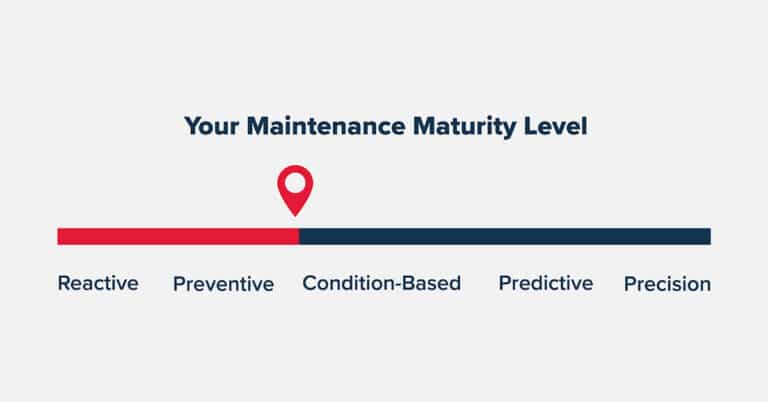
To be at the upper level of the maturity model, it’s not necessary that every piece of equipment be covered by predictive or precision maintenance—for some items, these processes would be overly complex. What is required, though, is that the organization assess the type of maintenance strategy that is most appropriate for each item and implement it accordingly.
Thus, mission-critical machinery and systems will be instrumented and monitored, with analysis determining what maintenance to perform and when. However, for low-usage, low-criticality equipment, lower levels of attention may provide a better cost-benefit ratio.
One challenge in determining maturity is that it’s difficult to do with internal resources. Often a more accurate view is provided by engaging external experts who have the experience of different maturity levels in a wide range of industries. Then, once armed with this independent opinion, it’s possible to develop and implement an improvement plan.
Benefits of achieving maintenance maturity
In an organization operating at the highest levels of maintenance maturity, unexpected events like breakdowns have been virtually eliminated. This leads to:
- High levels of delivery schedule adherence
- The maintenance function stays within labor and parts budgets
- Lower spares inventories
- Higher product quality, due to reduced part-to-part variation
- Lower scrap levels
- Stronger compliance with relevant standards and codes
In these ways, maintenance maturity provides a powerful and effective means of improving the equipment reliability and productivity of any facility. This means businesses gain a competitive edge that can lead to greater success.
Technologies powering maintenance maturity
Effective asset maintenance needs lots of data. Some of that consists of the repair history retained in computerized maintenance management systems (CMMS), but much more comes from the assets themselves.
Until relatively recently, gathering that data required someone visit each piece of equipment to take notes, then transfer those notes into a record-keeping system. Today though, Industry 4.0 technologies have eliminated that labor-intensive work.
Industry 4.0 refers to the fusion of sensors with Industrial Internet of Things (IIoT) technologies such as Wi-Fi and cellular for data transmission, plus the use of powerful analytics, including AI, to discern trends and make predictions.
In maintenance, this means machine health monitoring via a mix of sensors, coupled with cloud-based platforms and appropriate types of IIoT technology. For an organization seeking to adopt a higher level of manufacturing and maintenance maturity, this is how it’s done.
These technologies support proactive maintenance strategies because they give teams early insight into small performance changes or inefficiencies before those turn into failures. With Industry 4.0 principles built into daily workflows, a plant can catch developing problems with less disruption to production.
Using manufacturing maturity models to improve business performance
Maintenance maturity model applications exist wherever a business or organization relies on equipment for revenue, profit and customer service. The purpose is to provide an understanding of the various maintenance strategies and help maintenance personnel make informed decisions about the types or levels needed throughout their area of responsibility to extend asset lifetimes.
Adopting higher levels of the model (predictive and precision maintenance) yields many benefits, including lower maintenance and production costs and reduced inventories. It also requires an array of tools and technologies, plus the expertise to deploy them wisely and understand the information produced. Partnering with an experienced maintenance and reliability organization provides an efficient ROI-driven maintenance strategy. Contact ATS to get started.