




Maintenance affects more than just machine availability. It also has a bearing on first pass yield (FPY). What is first pass yield? An important productivity metric, FPY highlights wasteful production and can be an important stimulus for continuous improvement efforts.
Understanding first pass yield is important because it tells manufacturers how much of their production output is usable without rework, repair or scrap. Low FPY rates can reveal process instability, material variation, operator issues, or poor equipment condition. Maintenance teams can examine FPY rates to reveal whether machine wear, poor calibration, tooling issues, or inconsistent asset performance are impacting the quality of products.
What’s the definition of first pass yield?
First pass yield refers to the number of good quality parts that come off a machine or production line. In this context “good quality” refers to them being acceptable to the customer, which may be a higher quality standard than simply meeting the specification. This is different from rework yield or rolled throughput yield, which is the number of units including those that require repairs or reworking. These two figures factor into total yield, which is the complete number of products that successfully go through all the necessary production steps.
FPY is often cited as part of manufacturers’ lean or Six Sigma initiatives, providing them with valuable metrics they need to make better decisions. Paying close attention to FYP supports operational goals including reducing cost-per-unit, improving total throughput yield and reducing waste. FPY is just one category of yield that manufacturers need to pay attention to in their processes:
Metric | What it measures | Why it matters |
First pass yield | Units that are acceptable without rework | Shows how often the process gets it right the first time |
Rework yield | Units accepted after correction or repair | Helps quantify how often quality is recovered through extra work |
Rolled throughput yield | Probability that a product passes through multiple process steps without defect | Useful for multi-step production processes |
Total yield | Final acceptable output after all work and rework | Shows total sellable production but may hide inefficiency |
How to calculate first pass yield
First pass yield is calculated as a percentage of the total number of parts produced; the formula is:
FPY = [(Number of saleable parts produced) / (Total number of parts produced over that time period)] x 100
Readers familiar with the Overall Equipment Effectiveness (OEE) calculation will notice the similarity with the quality score component. In OEE quality performance is expressed in time whereas the FPY calculation uses number of units, but given a fixed part production rate, these two are interchangeable.
It’s also important to note what counts as a “non-saleable” part. These typically include units that feature dimensional deviations, cosmetic defects, incomplete assembly and/or other flaws that require reworking. Best practice is to count products as first-pass good only if they meet quality expectations without repair, rework, cleaning, sorting, or additional processing. Units that can be fixed and sold later may contribute to total yield, but not first pass yield.
Example of first pass yield in action
Working through the formula with numbers from a hypothetical production process will illustrate how it should be used.
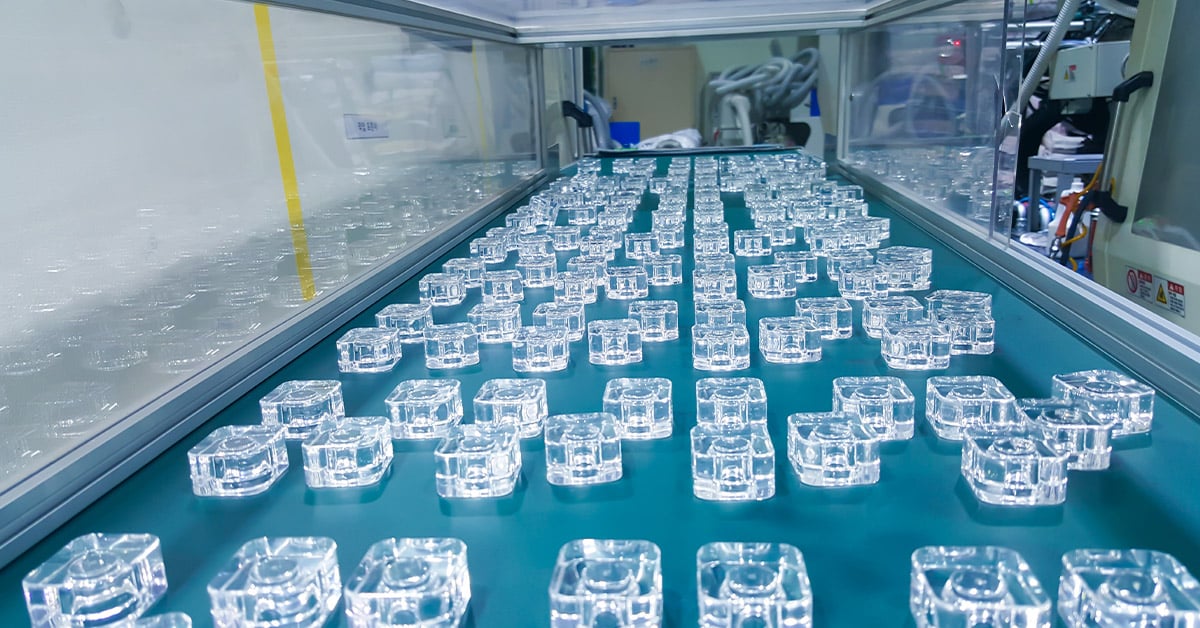
Consider a molding machine that ejects 10 plastic parts per cycle and runs at 10 cycles per hour. In a full hour it will produce 100 parts.
These are then weighed to check for sufficient material and 5 are found underweight. Then the number of parts meeting specification is 95.
Visual inspection subsequently discovers 3 parts are coated with mold release. They can be cleaned and sold, but this needs more work. Therefore, these parts are not of saleable quality direct from the machine.
In this example, FPY = [(100- (5+3))/100] x 100 = 92%. This might seem high, but that 8% of waste can represent thousands of dollars lost every week.
Benefits of measuring first pass yield
FPY shows the proportion of units being wasted due to product quality problems. This is a significant productivity issue because:
- Nonconforming product must be reviewed and a decision made whether to rework or scrap.
- Rework is expensive.
- Scrapping the products means material and machine capacity were wasted.
- If scrap products can’t be recycled (castings for example can be remelted and the alloy used again), disposal may carry additional costs.
Reporting FPY frequently, perhaps via a dashboard, shows whether quality levels are constant, falling, or hopefully rising. A declining metric should prompt some investigation as to the cause. Any FPY improvement will show that corrective actions have been effective. Here are some examples of the many benefits measuring FPY can bring to manufacturing operations:
FPY benefit | Why it matters |
Reveals hidden waste | Shows rework, scrap and extra processing that total yield may hide |
Improves cost visibility | Connects defects to material, labor and machine capacity loss |
Supports continuous improvement | Helps teams measure whether corrective actions are working |
Highlights process instability | Shows when quality control performance is drifting |
Connects quality and maintenance | Helps identify equipment-related defect patterns |
Supports better throughput | More first-pass good parts means less capacity lost to rework |
How to improve first pass yield
The start point is to analyze the reasons for product not being of saleable quality straight from the machine. Typically, these will be presented in the form of a pareto chart, letting management focus on the biggest quality issues.
Processing yield problems generally fall into one of the following four types:
- Defective material: If raw material varies in composition, perhaps as a result of coming from a different supplier, it may process differently and so achieve different results. For example, it may have a different curing behavior or glass transition temperature.
- Workers deviating from Standard Operating Procedures (SOPs): Changing the assembly sequence or using the wrong tool could result in a product not performing as designed. An example would be using a fastening tool set to the wrong torque, or not torquing a fastener at all.
- Damaged, worn or dirty tools: For example, chipped cutting tools and dirty molds give rise to dimensional errors and poor surface finishes. This includes equipment that has not been properly serviced, such as a packaging machine with seals that should be replaced that causes packages to fail.
- Excessive variation in the process: Wear in guides, bushings and other machine parts can lead to misplacement of holes or labels. Fill quantities might vary more than they should, appearance can suffer and functionality might be reduced.
While material problems and failures to follow SOPs (or the absence of SOPs), should be addressed by Purchasing, Quality and Operations management, many of the machine-related problems fall within the maintenance sphere.
The maintenance function should implement a planned maintenance program to detect and correct for wear in machine parts. This could be done on a time basis, although a more effective approach is to implement some form of machine health monitoring. This flags deviations from normal operation to the CMMS or the maintenance planning team so replacement parts can be ordered and corrective actions scheduled for when they are least disruptive.
The role of maintenance in FPY optimization
Having the right maintenance strategy in place can make a world of difference in a manufacturer’s FPY metrics. Keeping equipment online and in good working order is critical for preventing defects and inconsistencies that can hurt FPY. Predictive maintenance driven by machine health monitoring systems and advanced analytics helps ensure that unexpected downtime is kept to a minimum. With CMMS integration, trends in defect rates can be tracked to guide technicians’ activities and track the root causes of such defects.
Different maintenance tasks play different roles in improving FPY, as seen below:
Maintenance action | FPY improvement opportunity |
Preventive maintenance optimization | Ensures PM tasks target known quality risks |
Machine health monitoring | Detects abnormal conditions before defects increase |
Predictive maintenance | Helps schedule repairs before equipment failure or quality loss |
Calibration checks | Reduces measurement, torque, fill, or alignment errors |
Tooling inspection | Prevents defects from worn or damaged tools |
Lubrication management | Supports stable machine motion and reduces wear |
CMMS/work order tracking | Connects defect trends to maintenance history |
Root cause analysis | Prevents repeat quality issues tied to equipment condition |
Address FPY in manufacturing
First pass yield is an important, though sometimes overlooked, performance metric. It indicates the proportion of production time and materials that are being wasted making parts that can’t be sold.
Analyzing the reasons for a poor or declining FPY will reveal opportunities for improvement. Multiple functions will be involved in addressing these, including Maintenance. As a leader in outsourced industrial maintenance, ATS works with manufacturers to improve asset utilization and performance. Contact us to learn how we could help raise FPY in your operations.