



Availability, quality and performance are essential indicators of manufacturing performance, and all can be enhanced with industrial remote monitoring. With real-time remote monitoring data, manufacturers gain a clearer view into what is happening across their machine, lines and facilities. Maintenance teams especially benefit from that level of visibility because it enables them to identify abnormal equipment conditions earlier, reduce unnecessary inspections and support stronger decision-making about when to inspect, repair or replace remote assets. Strong remote monitoring programs aren’t limited to dashboards but connect alerts to maintenance action.
What is industrial remote monitoring?
Industrial remote monitoring utilizes sensors, connected devices and analytics platforms to collect data from equipment or processes. “Remote” in this context refers to the person acquiring or using data from a machine not being physically present at the machine. Instead, data is gathered by sensors and communicated to where it is viewed, analyzed and stored. This makes it possible for maintenance teams to monitor performance, identify abnormalities and respond without needing to be physically present at the machine.
Remote monitoring systems are set up to:
- Determine if machinery is running
- Count machine output
- Assess if a process is in control
- Identify if attention will be needed soon
- Monitor emissions
Recent years have seen rapid advances in the sensing, communications and analysis technologies used for remote machine monitoring.
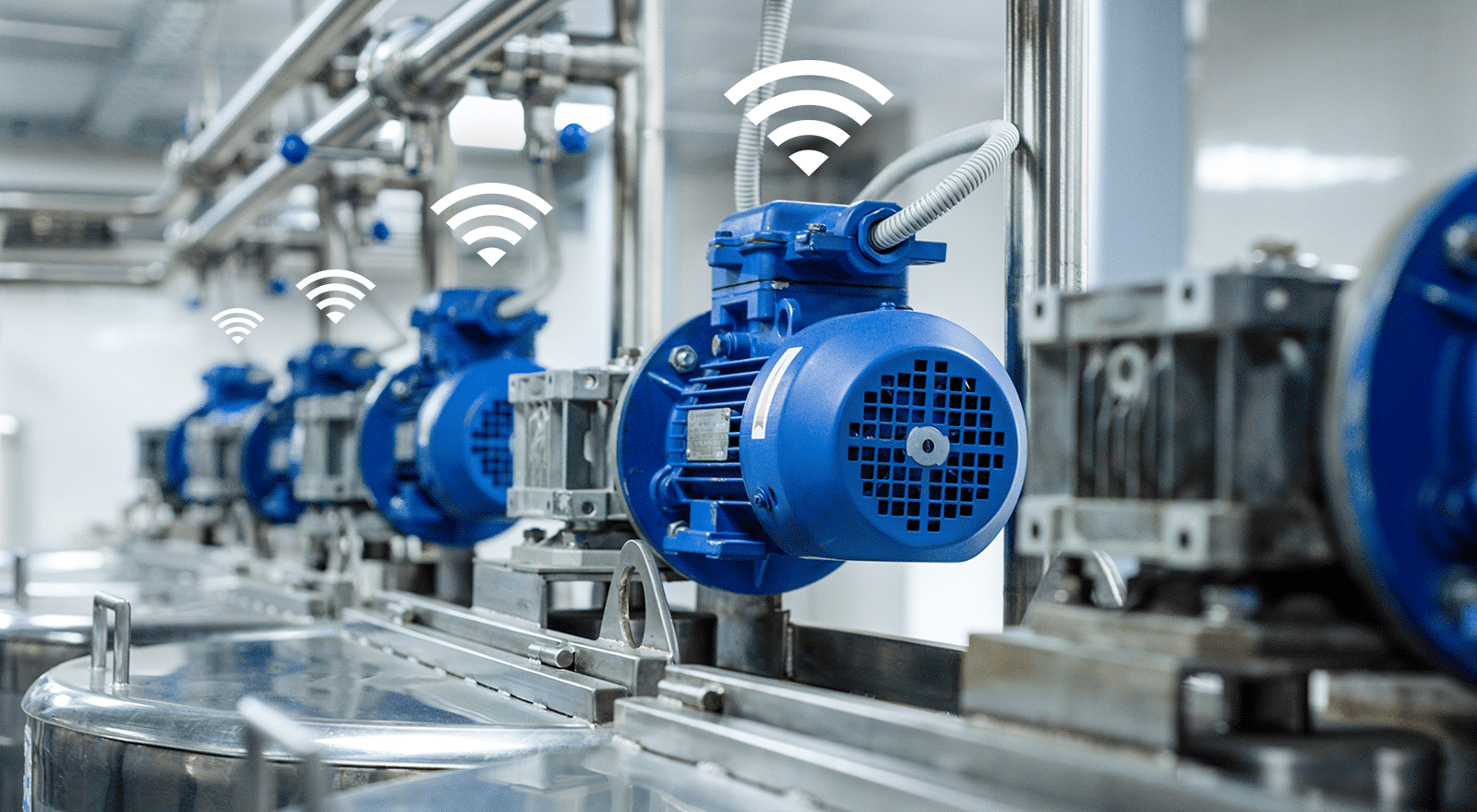
Sensors have become smaller and faster and have gained the ability to process, send and, in some cases, receive data. This is done using wired and wireless protocols ranging from USB and Ethernet to Wi-Fi and cellular networks. The result is “smart” or “Internet of Things” (IoT) sensors.
Additionally, sensor data can now be stored and shared at minimal cost in the cloud. These cloud storage solutions let authorized users view and analyze the IoT sensor data from any location. This enables rapid problem identification, along with benchmarking comparisons that help businesses find and implement improvements in machinery and process operation and maintenance.
Whereas analysis was once the domain of engineers with spreadsheets, today it is being taken over by real-time data analytics tools. These receive data from remote sensors (which may already have been filtered and analyzed by “edge” devices at the machine) and process it into information yielding valuable insights into the equipment, the process and the product. Going forward, much of this processing will be done by or aided by AI.
Remote monitoring component | Role in manufacturing |
Sensors | Collect machine, process or environmental data |
Edge devices | Filter or process data close to the machine |
Connectivity | Transmits data through wired, wireless, Wi-Fi, cellular, or industrial networks |
Cloud or local platform | Stores, organizes and displays monitoring data |
Analytics tools | Identify trends, anomalies and alerts |
Maintenance workflow | Turns findings into inspections, work orders or corrective action |
Applications of remote monitoring in manufacturing
Remote equipment monitoring is used in many industries, from water treatment to power generation. Within manufacturing, the most widely used applications relate to machine condition monitoring, energy consumption and emissions. More specifically, possible applications include:
- Equipment maintenance: Real-time continuous monitoring of parameters indicating equipment health. This includes oil levels, pressures and conditions, bearing and spindle vibration and temperature logging. This operational data is used to schedule maintenance activities based on actual equipment conditions rather than a calendar or operating hours basis.
- Predictive maintenance: An emerging application for machine health monitoring is using data analytics to predict potential equipment failures. This allows maintenance to be postponed until shortly before a breakdown is expected to occur.
- Production line monitoring: Real-time tracking of production rates and process conditions, plus the results of quality control checks carried out by automated tests and measurement equipment.
- Energy management: Industrial IoT remote monitoring devices are effective in sustainability and cost-reduction efforts allowing the ability to monitor and optimize energy usage.
- Supply chain management: Remote monitoring can go beyond watching machine output and health to cover inventories of raw materials, consumables and MRO items. Using technologies like bar code reading and RFID tags, particularly in conjunction with machine and process monitoring, supports real-time tracking of inventory levels and logistics, along with streamlined MRO procurement.
- Environmental monitoring: With remote monitored systems like waste treatment and furnace/smokestacks, it’s easier to ensure and demonstrate compliance with environmental regulations and sustainability goals.
Looking to connect remote monitoring alerts to work orders and repairs? Talk to ATS about maintenance execution support.
Key benefits of remote monitoring solutions in manufacturing
Remote process and industrial equipment monitoring impacts:
- Operational efficiency
- Asset care
- Productivity
- Quality
- Maintenance costs
- Safety
Here’s a closer look at each.
Operational efficiency
Changes and trends that, if not addressed in a timely manner, would lead to nonconforming product, other forms of waste or uncontrolled chemical releases, are detected promptly. This enables quick responses that reduce unplanned downtime and improve OEE.
Asset care
Predictive maintenance based on data insights from reliability monitoring enhances the effectiveness with which equipment maintenance is carried out. This reduces maintenance costs and extends equipment lifespans.
Productivity
Improvements in availability and quality reduce the impact of bottlenecks on output. This reduces idle time at non-bottleneck operations and allows more productive use of assets throughout manufacturing.
Quality
Continuous monitoring of processes enables immediate identification of trends that would otherwise result in conditions outside of required limits. Likewise, monitoring product quality parameters enables prompt reaction to problems, reducing levels of defects, rework and scrap.
Costs
Material consumption drops as quality improves, energy efficiency is higher as processes are better optimized, and costs resulting from unplanned machine downtime are avoided. Maintenance expenses are lower because machines can go longer between servicing, and there’s less need for breakdown maintenance. In many cases, it’s even possible to reduce maintenance spares inventories as replacement parts can be ordered just before they are needed.
Safety
Remote monitoring improves safety in many ways. Potentially unsafe operating conditions are identified quickly, with alerts being issued automatically, so they can be addressed before they lead to more serious problems. Compliance with safety regulations is higher, and the frequency with which workers need to enter potentially hazardous areas is reduced.
Remote monitoring for multi-site manufacturing operations
For manufacturers operating multiple locations, remote access to real-time data can make a tremendous difference. Maintenance and reliability leaders can compare asset health, downtime risk and performance across numerous facilities at the same time. Rather than relying on site-level reporting, remote monitoring gives enterprise teams the ability to see where assets are trending towards failure, where alerts are occurring the most and where support may be needed.
It should be noted, however, that standardization is key to making this work for multi-site manufacturing operations. Consistency is needed through asset naming, alert thresholds, reporting formats, CMMS processes, and escalation workflows to support proper benchmarking while still allowing each site to react to local needs.
Get more from your assets
IoT sensors, coupled with cloud storage and real-time data analytics have made remote monitoring an essential tool for industrial manufacturers. By providing new insights into machinery operation and condition it enables more effective maintenance and process control, leading to less downtime, better quality and higher OEE.
ATS helps manufacturers improve equipment reliability and availability and better manage their maintenance costs. Our services range from short term support to predictive maintenance solutions that harness the potential of remote monitoring.
Not all condition monitoring solutions are created equal. Learn more about the value Reliability 360® Machine Health Monitoring can bring to your operations below. Ready to get started? Contact us today.
What's included? | Reliability 360® Machine Health Monitoring | Alternatives |
Custom Installation & Plant Assessment |  | |
Real-Time Continuous Equipment Monitoring | | |
Onboarding Program & Knowledge Base | | |
Analytics Dashboards & KPIs | | |
Customizable CMMS/ERP Integration | | |
US-Made Hardware & US Managed | | |
20+ Sensor Types | | |
Optional Maintenance & Parts Services | | |
Guaranteed ROI | | |