



Manufacturers are continuously striving to overcome challenges, improve processes and identify efficiencies, and the manufacturing trends that we see coming in 2026 are all in service of these goals. As is typical, manufacturing industry trends are largely driven by technological advances, marketplace needs and the objectives of the business.
As we look ahead to the immediate future of the manufacturing industry, global supply chains continue to experience disruptions and automation is always making incremental moves forward, meaning that some of these trends will carry over—but there are brand-new challenges and opportunities ahead. Some of the biggest issues impacting investment planning in the past year included energy volatility, geopolitical conflicts and interest rate pressures. Looking back, 2025 nevertheless was a year marked by cautious growth, stabilization of supply chains and rapid digital transformation. We believe 2026 will bring a greater emphasis on resilience, scalability and smarter, more autonomous operations.
Read on to discover what we believe could be the top industrial manufacturing trends for 2026.
The top 10 latest trends in manufacturing technology for 2026
1. The continued rise of smart factories
Factories and manufacturing facilities have passed the tipping point of smart factory adoption, moving from occasional or sporadic implementation of smart manufacturing initiatives and equipment to more full-fledged systems, taking advantage of the full potential of data analytics and communication between machinery and central monitoring tools. Why? For several reasons:
- As older equipment continues to be phased out, newer machines come equipped with onboard sensors and monitoring tools.
- Manufacturing businesses will be increasingly motivated to implement smart technology in order to keep pace with competitors who are seeing the benefits of the same.
- New developments in Industry 4.0 including enhanced machine learning capabilities and integrated systems for real-time data analytics are making it possible for manufacturers to make strides in terms of predictive maintenance and process optimization. These advancements are no longer considered emerging innovations—they’re becoming the standard foundation for predictive maintenance and process optimization.
The costs of aftermarket sensors and other smart manufacturing software and equipment continues to drop, while the benefits—more proactive and effective maintenance, greater insight into process efficiency, a reduction in overall operating costs—become ever-more apparent. For example, AI copilots for operators make it possible to overlay detailed instructions on a wearable display. This cuts down on the need to refer to printouts and keeps work flowing. Autonomous monitoring also makes quality control more streamlined, and sensor technology is enabling closed-loop manufacturing systems that learn from mistakes and reduce waste through automatic adjustments.
2. Increased focus on sustainability and carbon neutrality
As ESG—environmental, social and governance—issues become more of a concern for manufacturers, the importance of sustainable manufacturing processes and pursuit of carbon-neutral practices will become more prominent. In addition to sustainability requirements for government, municipal, and institutional contracts, manufacturers can expect to see more ESG requirements from commercial customers as well. At the same time, there is a growing interest in carbon capture technology and the ongoing integration of renewable energy in factory spaces. Circular manufacturing that reuses as much post-consumer content as possible is another trend that should gain prominence over the next few years. These are expected to drive even further advancements in sustainability for manufacturers.
3. Artificial intelligence and virtual processes
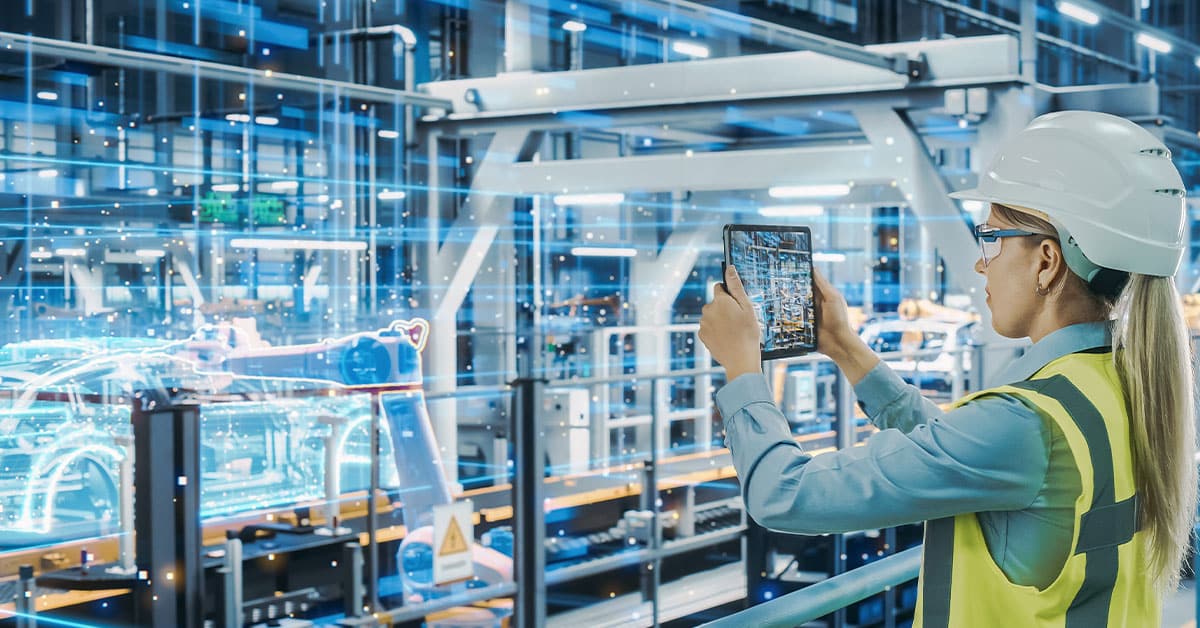
Technologies such as digital twins, machine learning, AI (artificial intelligence), AR and VR (augmented reality and virtual reality) are helping manufacturers become more effective and efficient by enabling remote monitoring, servicing and equipment operation—all without the need to be on-site. With communication approaching real-time, and the computing power to make it truly seem like the operator is in the room with the machine, virtual and remote operation is in keeping with other recent trends in manufacturing technology that enable access, flexibility and safety.
In fact, this technology has led to the development of so-called “dark factories,” which are those that are entirely automated. The widespread use of AR and VR in manufacturing is expected to make such facilities a more common element of many manufacturers’ operations. It’s expected that 2026 could see a leap forward in so-called “cognitive automation,” which uses advanced AI to optimize automation on the fly based on machine learning algorithms. Edge AI brings the computing power even closer to the production floor by running models directly on devices rather than in the cloud. This has the potential to make actionable insights even more immediate. At the same time, manufacturers will need to be more mindful of the burgeoning governance requirements surrounding AI, including transparency and labor considerations.
4. Data-driven maintenance as a margin enhancer
Sensors, remote monitoring, connected devices and the Internet of Things (IOT) have appeared on lists of digital trends in the manufacturing industry for the past several years and that continues this year. Why? On one hand, sensors continue to become more commonplace, communications are even faster and more reliable, and manufacturers are innovating more effective ways to use data to drive predictive maintenance. More effective, efficient maintenance is crucial given the financial hardship that many facilities faced in the last few years and may continue to face in the near future. Since predictive maintenance can vastly reduce unplanned downtime, creating material cost savings is now more important than ever.
5G networks and AI-driven root cause analysis give manufacturers the bandwidth and speed necessary to deliver more information from devices to the central server. Armed with this knowledge delivered through OEE dashboards, it’s possible for them to do even more to prevent costly downtime. New predictive analytics tools and scalable maintenance analytics also have the potential to help manufacturers optimize the lifespan of their equipment and keep it online for longer than ever before.
5. Supply chain reassessment
Ongoing supply chain disruptions continued to make waves over the last few years, driving home just how precarious the normal status quo has been for nearly every facility and business. Thus, it is unsurprising that in 2026, the supply chain continues to hold a prominent position as an area for continuous monitoring, management, and improvement, with facilities seeking creative ways to add flexibility and reliability while also retaining value. Data is one such means, with data-driven inventory supply management as an effective way to identify previously unknown supply chain efficiencies. Manufacturers can use data to more quickly adapt to the uncertainties of the supply chain landscape and work to minimize disruptions, which continue to be unpredictable. Geopolitical risk modeling tools provide valuable insights to help manufacturers anticipate and prepare for disruptions caused by instability around the world. Utilizing the blockchain to manage this data brings traceability, while the advent of real-time supply chain tools can help manufacturers stay on top of everything. Supply chain resilience and flexibility strategies such as diversified sourcing and automation are expected to be especially relevant in the near future, as well.
6. Changing focus from B2B to B2C
Advancements in new manufacturing technology and supply chain strategies are making it possible for many manufacturers to reconsider their relationships with consumers. Rather than relying on retailers or distributors to serve as the middleman, many manufacturing companies today are selling their products directly to the consumer through e-commerce platforms and other methods. Examples of emerging technology in manufacturing such as smart factories also enable greater customization options today, which creates new opportunities for manufacturers to connect directly with consumers. With more people than ever doing their shopping online, this ongoing shift away from B2B to B2C should only become more prevalent in the coming year, especially as more manufacturers integrate digital storefronts into their online presence.
7. The ongoing importance—and permanence—of reshoring
In the recent past, reshoring was often presented as a lofty goal for the manufacturing sector, illustrating a renewed focus on quality, service and fulfillment speed. In the last few years, the importance of doing business closer to home was thrown into sharp relief, with reshoring becoming a necessary way to bolster continuity—not simply a buzzword. In 2026, reshoring is settling in as a more feasible and necessary supply chain solution, evolving beyond a response to a temporary challenge to become a more conventional way of operating. There’s also a trend toward nearshoring partnerships that seek to bring operations closer to manufacturers’ home territory, if not within its borders. Ongoing geopolitical shifts further underscores the need for reshoring as a strategy in the near future.
8. Employee safety and health
Always a primary concern, employee safety is not often viewed as a “trend” so much as something that should be observed and fostered every day. This has led to the adoption of new ways of monitoring and maintaining employee health that are as important for your workforce as they are for your business. Some facilities are choosing to employ more advanced equipment to monitor employee locations and movement to track injury risk and illnesses. Wearable devices backed by AI-enabled analysis are expected to give manufacturers even more insights into the safety of their employees in the years to come. This comes just in time to meet the growing regulatory pressure calling for real-time digital safety reporting.
9. 3D printing and additive manufacturing
3D printing technology and other additive manufacturing technologies have come a long way in recent years, becoming far more accurate, flexible and cost-effective than ever before. This has been one of the most significant changes in the manufacturing industry in recent years and should continue well into the future. Not only does it allow for rapid prototyping and greater customization of products, but it also has the potential to make maintenance and repairs much faster and easier. Technicians may be able to print a replacement part in a fraction of the time it would take to source parts from a warehouse, cutting downtime to a minimum. Manufacturers also are beginning to adopt hybrid equipment and processes that combine additive manufacturing with traditional subtractive methods.
10. Meeting increased demand with a decreased labor force
Concerns about the labor force combined with existing industrial industry trends in the landscape means that a manufacturing company must be more efficient and nimbler than ever in addressing the skills gap and labor shortages. This requires a top-to-bottom evaluation of all production processes, identifying ways to increase operational efficiency and support the workforce while bridging the skills gap and providing cutting-edge technical training to meet today’s needs. Leveraging new manufacturing technology such as augmented reality and AI-driven training platforms may be the answer for bringing new employees up to speed as quickly as possible. As technology becomes much more prevalent, manufacturers must prioritize upskilling employees in AI and building greater automation literacy to ensure long-term success.
11. Cybersecurity in manufacturing
As IIoT technology continues to gain footholds in the manufacturing sector, there will be an increased emphasis on protecting the data used by these systems. Cyberthreats targeting industrial control systems and operational technology networks are on the rise, and security measures have to take a step forward in kind. Because the modern factory is so connected, cyber incidents can bring about physical downtime. Some of the tools manufacturers are expected to use in the coming years include zero-trust architecture, AI-driven threat detection and advanced encryption. Providing secure remote access for maintenance and support teams also needs to be a high priority for manufacturers in this new environment.
Preparing for 2026: Where manufacturers should focus next
Some of these manufacturing trends build on those with which you may be familiar from past years, and some are new as a result of today’s unique challenges. To stay ready for what 2026 may bring, manufacturers should focus on:
- Building digital maturity plans
- Investing in workforce development
- Implementing predictive maintenance
- Building resilient supply chains
- Advancing ESG strategy with measurable KPIs
As a technology-driven maintenance company, ATS can help with your goals and objectives to grow your operations this year and beyond. For more information, contact us today.