
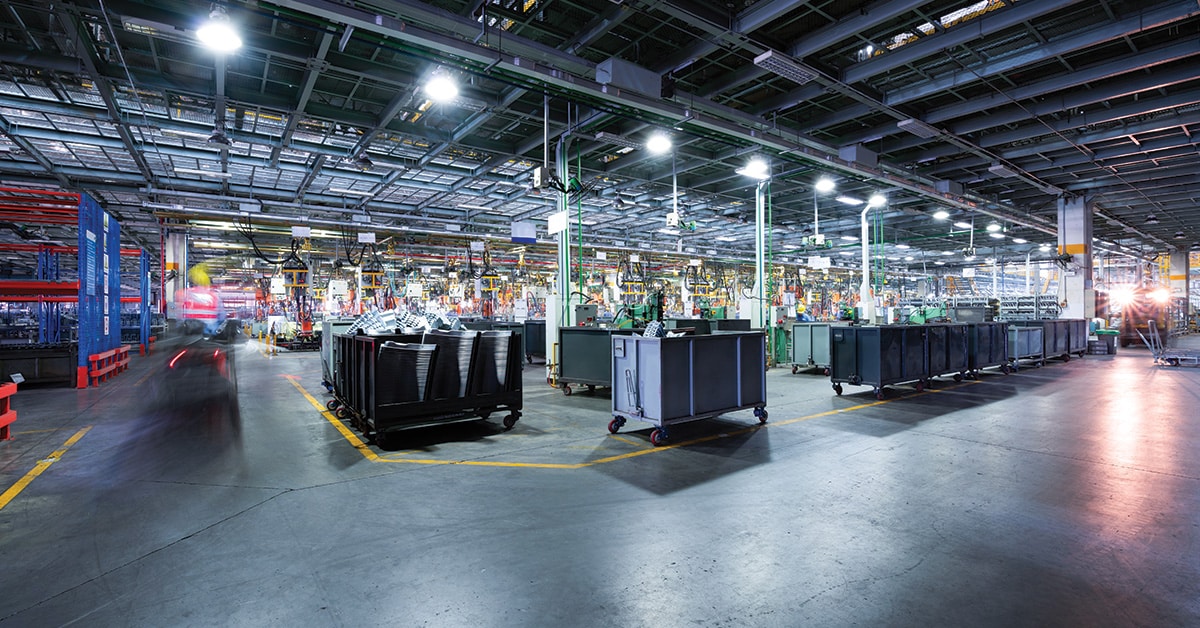




Modern manufacturing relies on the precise control of machines, materials and environmental conditions to meet production targets and ensure product quality.
But this is no easy task. According to recent data, 79% of manufacturing executives are affected by skilled labor shortages, and 90% say manufacturing departments are the most affected. As many as 69% plan to invest in solutions such as robots and cobots to help bridge the gap. The result is a fragmented operational environment that can frustrate efforts to track, monitor and manage operations at scale.
Process control systems (PCS) leverage connected technologies to monitor and regulate industrial processes such as temperature, pressure, speed and flow. By collecting data in real time, process control systems can help improve productivity, maintain quality standards and reduce operational risks.
What are process control systems?
A PCS carries out automated monitoring and real-time regulation of industrial process control to ensure process variables remain within target ranges. These systems can also notify staff if operations are outside of tolerances, allowing maintenance teams to take action before equipment fails.
Common variables controlled by PCS include:
- Temperature
- Pressure
- Flow
- Level
- Speed
These variables are often managed using what’s known as a proportional-integral-derivative, or PID controller.
Examples of industrial processes that benefit from PCS deployments include auto manufacturing, food processing and oil refining. The more complicated and in-depth the process and its component parts, the greater the benefit derived from PCS.
How process control systems work
Process control systems operate in a loop. This allows for continuous automation and adjustment of processes to meet expected outcomes.
Here’s an example of a typical PCS loop:
1. Sensors measure process variables and send this data to controllers
2. Controllers analyze data and compare this data to setpoints
3. Actuators adjust equipment operations if values fall outside setpoints
4. Feedback loops ensure that stability is maintained
5. Continuous monitoring data is used to make adjustments
6. Sensors use adjusted inputs to measure process variables
Process loops may be open or closed. Open-loop systems have no feedback system, while closed-loop systems use feedback to make process adjustments.
Key components of a process control system
A process control system is made up of multiple technologies working in tandem. Common components of a PCS include:
- Sensors and instrumentation
- Distributed control systems (DCS)
- Human-machine interfaces (HMIs)
- Supervisory control and data acquisition (SCADA) systems
- Actuators and valves
- Communication networks
- Industrial control software (ICS)
Consider an automotive manufacturing plant that has been struggling with poor-quality outputs, in turn reducing the on-time delivery (OTD) rate. The company contracts a provider to develop and install a process control system to help pinpoint issues and enable remediation.
This starts with sensors. Common types of industrial sensors include vibration, temperature and pressure sensors that are connected to equipment along the entire production line. Sensors collect operational data, which is then analyzed by controllers and sent to HMIs via DCS.
Evaluation of data reveals an issue with a specific piece of assembly equipment; it is operating at too high a temperature, and its temperature has been steadily rising for months. As a result, any outputs from the equipment do not meet setpoint objectives.
Using this data, teams leverage SCADA and ICS systems to adjust actuators and control valves, in turn lowering the overall equipment temperature. If this is unsuccessful, maintenance teams are dispatched to conduct a more thorough inspection and repair or replace parts as needed.
Once the issue has been remediated, PCS operations start again, with any new issues reported and addressed ASAP.
Types of process control systems
There are four common types of process control systems. Here’s a look at each in more detail.
Open-loop control systems
Open-loop systems have no feedback mechanism. Processes are carried out based on preset rules and are not adjusted if conditions change. For example, a machine programmed to carry out X process for Y minutes will do exactly that—and nothing more—until the open-loop is modified.
Recommended for: Simple industrial automation processes that require consistency and repetition.
Closed-loop control systems
Closed-loop systems include a feedback component that allows systems to monitor manufacturing process performance and output and make adjustments as necessary.
Consider the example above. Feedback may indicate that the X process should be carried out for Z rather than Y minutes to optimize performance. In a closed-loop system, this adjustment is made automatically, enabling the implementation of advanced functions such as model predictive control (MPC).
Recommended for: Most industrial applications.
Distributed control systems (DCS)
Distributed control systems cover a larger area than their open and closed-loop counterparts. They connect multiple, disparate controllers and processes to create a decentralized PCS that can be easily scaled or modified if needed.
Recommended for: Large-scale industrial operations such as chemical manufacturing or power generation.
PLC-based control systems
PLC-based control systems offer high-speed automation across disparate processes. They are typically used in discrete manufacturing operations where direct control of machinery and equipment is paramount to ensure output quality.
Recommended for: Discrete manufacturing operations.
Common applications of process control systems
Process control systems are used in many manufacturing applications. Some of the most common include:
- Assembly line automation: Using PCS to automate assembly lines can reduce the risk of material waste and production bottlenecks.
- Furnace temperature control: Making PCS part of furnace temperature control processes can help limit overspending on fuel and create a real-time record of temperature variations.
- Chemical processing: In chemical processing plants, closed-loop PCS can be used to monitor component usage and adjust levels as required.
- Food and beverage production: For food and beverage companies, process control systems are an integral part of contamination monitoring and response.
- Packaging operations: PCS benefit packaging operations by helping companies track average packing times and identify areas for improvement.
- Material handling systems: Using PCS for material handling systems provides real-time data about material wastage volumes.
- Energy and utility management: Energy and utility management companies can leverage PCS to track fluctuations in consumption or output.
- Environmental and safety monitoring: As part of environmental and safety monitoring programs, PCS provides real-time data about operating conditions, enabling companies to make targeted adjustments that improve compliance.
Benefits of process control systems
Implementing process control systems offers multiple benefits, such as:
- Improved product quality and consistency
- Reduced risk of human error
- Increased production efficiency
- Enhanced equipment reliability
- Lowered operational costs
- Reduced material waste
- Improved workplace safety
- Faster response to process variations
The caveat? Choosing the right PCS approach for your manufacturing framework to maximize benefits.
Process control systems and Industry 4.0
PCS architecture isn’t static. Instead, process control systems are evolving to keep pace with emerging trends such as Industry 4.0.
For example, many systems now integrate with always-connected IIoT sensors that enable real-time condition tracking and production monitoring. These systems can also be integrated with advanced analytics tools, in addition to MES, ERP and CMMS systems.
Finally, many companies are deploying machine learning and AI in manufacturing to improve closed-loop feedback and enable systems to intelligently respond as conditions change.
At scale, the evolution of process control systems is tied to the larger shift toward smart factory connectivity that sees manufacturing operations as a unified whole, rather than a series of connected steps.
Process control systems and maintenance control strategy
Effective integration of process control systems also supports maintenance operations.
Key functions include:
- Monitoring equipment performance
- Detecting abnormal operating conditions
- Supporting predictive maintenance
- Automating alerts for equipment issues
- Leveraging data for root cause of failure analysis (RCFA)
- Integrating operations with maintenance planning systems
Best practices for optimizing process control systems
Process control systems are designed to enhance manufacturing performance and reduce the risk of unplanned downtime. PCS solutions themselves, however, can also benefit from regular review and assessment to enhance their effectiveness.
Here are six best practices to optimize PCS effectiveness:
1. Routine calibration and testing
Regularly test and calibrate process control systems to ensure the accuracy and reliability of predictive maintenance sensors and feedback control loops.
2. Preventive maintenance for control equipment
Process control systems aren’t immune to failure. Make sure to schedule preventive maintenance for all PCS components to avoid unexpected breakdowns.
3. Operator training
While process control systems can make automatic adjustments, operators should review these adjustments to ensure they are in line with manufacturing goals. As a result, training is critical; operators need to know how control systems work, how to adjust feedback loops and when to report potential problems.
4. System redundancy for critical processes
It’s also worth building in redundant PCS for critical processes. This extra layer offers protection against unexpected system crashes or data corruption.
5. Continuous monitoring and analytics
In the same way that process control systems continuously monitor operations, companies should continuously monitor and analyze PCS functions to improve visibility.
6. Integration with reliability programs
Reliability monitoring is the core of manufacturing operations. Integration of PCS with reliability programs provides a holistic view of operations.
Control the process, improve the outcome
Process control systems help ensure stable, effective production through process automation, real-time monitoring and closed-loop feedback. Integration with Industry 4.0 technologies expands PCS performance, while connection with maintenance planning systems helps teams get ahead of potential problems and perform in-depth RCFA.
ATS can help your teams enhance process control and improve manufacturing outcomes. Our teams have expertise in building reliability-centered maintenance programs, implementing AI in predictive maintenance, deploying automation and control systems and developing continuous improvement initiatives.
Process control systems will continue to drive smarter manufacturing operations. Make the most of PCS with ATS. Let’s talk.
References
CADDi. (2026, January 20). 79% of manufacturing executives say skilled labor shortage is greatest challenge according to new CADDi research [Press release]. Business Wire. https://www.businesswire.com/news/home/20260120020694/en/79-of-Manufacturing-Executives-Say-Skilled-Labor-Shortage-is-Greatest-Challenge-According-to-New-CADDi-Research
