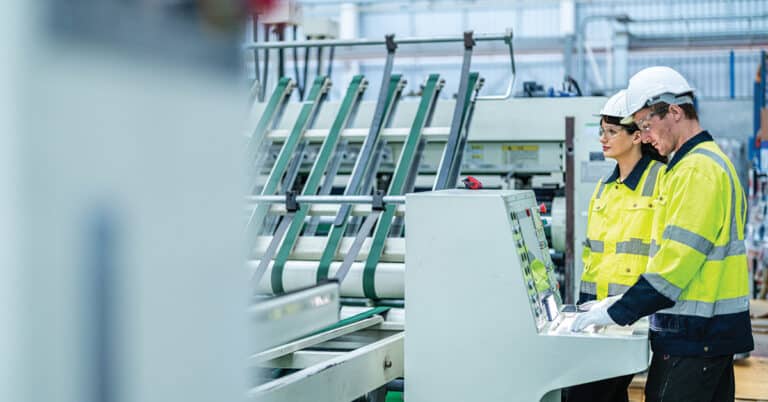





U.S. manufacturing is returning home.
A broader made in America manufacturing initiative focuses on rebuilding domestic production capacity. Many large enterprises and small businesses are now making the choice to onshore production practices, that is, they’re building and maintaining factories, assembly lines, warehouses and supply chains on American soil. As noted by Forbes, 69% of U.S. manufacturers have started onshoring their supply chains, with 94% reporting success.
Several factors are driving this return to domestic production. First are ongoing global supply chain disruptions. While most companies have adopted multi-modal supply chain models over the past few years, any long-distance supply chain comes with risks. These may include component sourcing issues, weather delays or local transportation challenges.
Geopolitical shifts also play a role. Evolving international relationships can create import/export issues that lead to higher costs and possible losses for manufacturers. Last, but certainly not least, are rising labor and energy costs. As homegrown power and American workers become more cost-effective, many companies are choosing to onshore or reshore operations.
For manufacturers, this shift brings both benefits and challenges. While closer to home means greater control over sourcing, supply chains, and staffing, this move also creates the need for more robust maintenance, reliability and service-partner strategies that drive uptime and performance.
This article outlines the key drivers, benefits and challenges of onshoring, and provides actionable maintenance strategies that reliability leaders can apply to keep production on track.
What is onshoring (and nearshoring) in manufacturing?
Until recently, offshoring was the most cost-effective approach for manufacturers. By moving production to countries with lower material and staffing costs, companies could save time and money even after taking into account the costs of permitting, licensing and logistics.
Changing market conditions, however, have made offshoring more risky and less likely to deliver ROI. As a result, both large and small manufacturers are making the move back home with onshoring and nearshoring.
What is onshoring?
Onshoring is the process of bringing manufacturing facilities and operations back to the United States. According to Newmark, more than $400 billion worth of investments have been pledged to create over 250 million square feet of industrial projects in the U.S. by 2030.
Onshoring vs. reshoring — Onshoring builds manufacturing capacity in a company’s home country. Reshoring moves previously offshored production back home.
What is nearshoring?
Nearshoring, meanwhile, moves manufacturing and supply chains to proximate countries, such as those directly connected by a land border. For companies in the United States, nearshoring often takes place in Mexico. According to a Cushman & Wakefield analysis, the United States now invests $138 billion in Mexican manufacturing operations, 4x more than the country’s next biggest investors, Canada and Spain.
What is offshoring?
Offshoring moves production, manufacturing and supply chain processes to other countries, typically those with lower labor or component costs. Increasing globalization, however, has closed the gap between the price of onshore, nearshore and offshore manufacturing.
Key drivers behind the shift to onshoring
The shift back to onshored operations isn’t monolithic. Multiple factors are driving the move, including:
- Supply chain resilience: Potential disruptors such as tariffs, transportation risks and political instability have helped move manufacturing back onshore.
- Labor cost and productivity changes: Rising overseas costs make onshore labor more affordable, while advanced automation enables high-value U.S. production.
- Energy, regulatory and incentive programs: Incentive programs help offset the cost of onshoring. For example, New York’s Manufacturing Assistance Program offers grants of up to $1 million for manufacturing projects that improve productivity or competitiveness.
- Technology and Industry 4.0: Domestic plants are now deploying robotics, 3D printing and automation to enable production. While many offshore plants are doing the same, staying local provides more transparency and control over the maintenance process.
- The CHIPS Act: The CHIPS Act authorized $280 billion in new funding to help boost domestic manufacturing of semiconductors.
- ESG and sustainability pressures: Companies face increasing pressure from governments and consumers to reduce emissions and improve sustainability. Onshoring offers access to shorter supply chains and domestic production and sourcing options that help reduce environmental footprints.
Benefits of onshoring for manufacturers
Bringing operations back home is net positive for manufacturers. One key benefit is the creation of American manufacturing jobs. This both boosts the local economy and engenders goodwill from the community.
Onshoring also offers other advantages, such as:
- Shorter lead times
- Lower logistics costs
- Closer proximity to quality control
- Improved manufacturing flexibility
- Easier systems integration
- Enhanced maintenance response
Challenges and considerations of onshoring
While onshoring offers both short- and long-term benefits for manufacturers, it also comes with challenges and considerations.
First are up-front capital costs. Companies must spend more to build, refurbish and automate local facilities. Time is also a factor. Depending on the nature of the project, it could take months to get production lines up and running. This means manufacturers will need plans in place to continue current operations and bridge the gap.
Workforce availability may also be a challenge. To optimize production lines, businesses require technical, maintenance and operationally skilled labor. As noted by Supply Chain Management Review, more than 20% of companies say they can’t reach full production capacity due to labor shortages.
Other concerns include transitioning supply chains to onshore or nearshore frameworks and adapting to the new parts and maintenance ecosystems these supply chains create. In addition, many companies with facilities on U.S. soil are still using legacy technology tools, which can create challenges when integrating with Industry 4.0 smart factory and IIoT initiatives. Finally, infrastructure and incentives vary by state. Some states offer financial incentives for companies to build or refurbish factories, while others rely on materials or labor availability to encourage construction. Some regions have robust power generation and transmission capacities, while others struggle to keep pace.
In combination, these challenges create maintenance risks. Older equipment retrofits can lead to unexpected downtime, and new assets come with different reliability profiles. As a result, manufacturers must ensure they have sufficient staff to create and carry out proactive maintenance strategies.
Implications for maintenance, reliability and service providers
For maintenance, reliability and service providers, this onshore shift underpins the need for new service strategies. They include:
- The development of advanced maintenance programs
- The need for regional service partner networks
- The integration of IIoT, condition monitoring and data analytics
- The recognition of reliability strategies as competitive differentiators
- The adoption of staff training and upskilling programs
How to prepare your maintenance strategy for an onshore operation
If your company is making the move to onshore operations, it’s worth taking the time to prepare your maintenance strategy. Streamline the process with these six steps:
Step 1: Conduct a maintenance readiness audit
Start with an audit to understand what you have and what you need. This should include an assessment of existing equipment health, current workforce skill levels and your functional level of digital maturity.
Step 2: Develop a reliability roadmap
Next is building an industrial reliability roadmap that’s tailored to the onshore manufacturing space. It should combine preventive maintenance strategies with predictive frameworks and digital solutions. Here, the goal is to create a maintenance framework that both prioritizes regular maintenance to address wear-and-tear issues while simultaneously identifying the root causes of ongoing concerns.
Step 3: Build partnerships with service providers
Service providers can help companies better manage onshore maintenance and reliability needs. Look for partners that offer both regional presence and multi-craft capabilities.
Step 4: Invest in training and upskilling
Skills are changing to meet the new demands of Industry 4.0. As a result, it’s worth investing in regular training to keep teams current and upskilling initiatives to navigate smart manufacturing, automation and IIoT frameworks.
Step 5: Consider maintenance and inventory optimization
Effective maintenance strategies depend on spare parts availability, which requires inventory optimization. In practice, this means the adoption of maintenance, reliability and operations (MRO) frameworks that can both accommodate domestic scaling needs and manage fast-change cycles.
For example, AI-powered MRO supply chain management systems can help enhance parts availability while reducing inventory spread.
Step 6: Monitor key performance indicators (KPIs)
KPIs are critical for ongoing maintenance success. Common indicators include:
- Equipment uptime
- Overall equipment effectiveness (OEE)
- Mean time between failures (MTBF)
- Maintenance cost per unit
Worth noting? While point-in-time measurements offer snapshots of current operations, long-term KPI-based machine health monitoring is critical for companies to get the big picture.
Partner with experts for onshoring operations
Onshoring, nearshoring and reshoring aren’t the only manufacturing trends impacting American manufacturers. For example, the rise of smart factories powered by IIoT networks and the integration of AI solutions into everyday business processes play a key role in long-term manufacturing success.
For many companies, however, managing these onshoring trends simultaneously is both cost- and labor-intensive. By partnering with industry experts such as ATS, manufacturers can manage multiple strategic initiatives without sacrificing reliability or revenue.
Bottom line? Onshoring is more than geographic relocation. It’s a strategic transformation for manufacturing that requires well-orchestrated action between maintenance teams, reliability programs and service providers to deliver maximum impact.
For operations and maintenance leaders, the message is clear: Capturing full value from an onshored, nearshored or relocated facility starts with a maintenance strategy that addresses current concerns and evolves alongside onshoring operations.
Contact ATS to assess your maintenance readiness for onshore manufacturing and build a reliability roadmap. Let’s talk.
References
Badlam, J., Clark, S., Gajendragadkar, S., Kumar, A., O’Rourke, S., & Swartz, D. (2022, October 4). The CHIPS and Science Act: Here’s what’s in it. McKinsey & Company. https://www.mckinsey.com/industries/public-sector/our-insights/the-chips-and-science-act-heres-whats-in-it
Cushman & Wakefield. (2023). U.S. manufacturing resurgence? Exploring the challenges and factors driving onshoring and nearshoring. Cushman & Wakefield. https://www.cushmanwakefield.com/en/united-states/insights/exploring-the-challenges-and-factors-driving-onshoring-and-nearshoring
Miller, J. (2025, January 13). Labor shortages remain an ongoing concern in many parts of U.S. manufacturing. Supply Chain Management Review. https://www.scmr.com/article/labor-shortages-remain-an-ongoing-concern-in-many-parts-of-u.s-manufacturing
Newmark. (2023, September). Manufacturing momentum: Advanced manufacturing ascendancy in North America. Newmark Insights. https://www.nmrk.com/insights/thought-leadership/manufacturing-momentum-advanced-manufacturing-ascendancy-in-north-america
NYC Business. (n.d.). Manufacturing assistance program. NYC Business. https://nyc-business.nyc.gov/nycbusiness/description/manufacturing-assistance-program
Vinoski, J. (2024, January 25). COVID is fading, but reshoring isn’t. Forbes. https://www.forbes.com/sites/jimvinoski/2024/01/25/covid-is-fading-but-reshoring-isnt/