
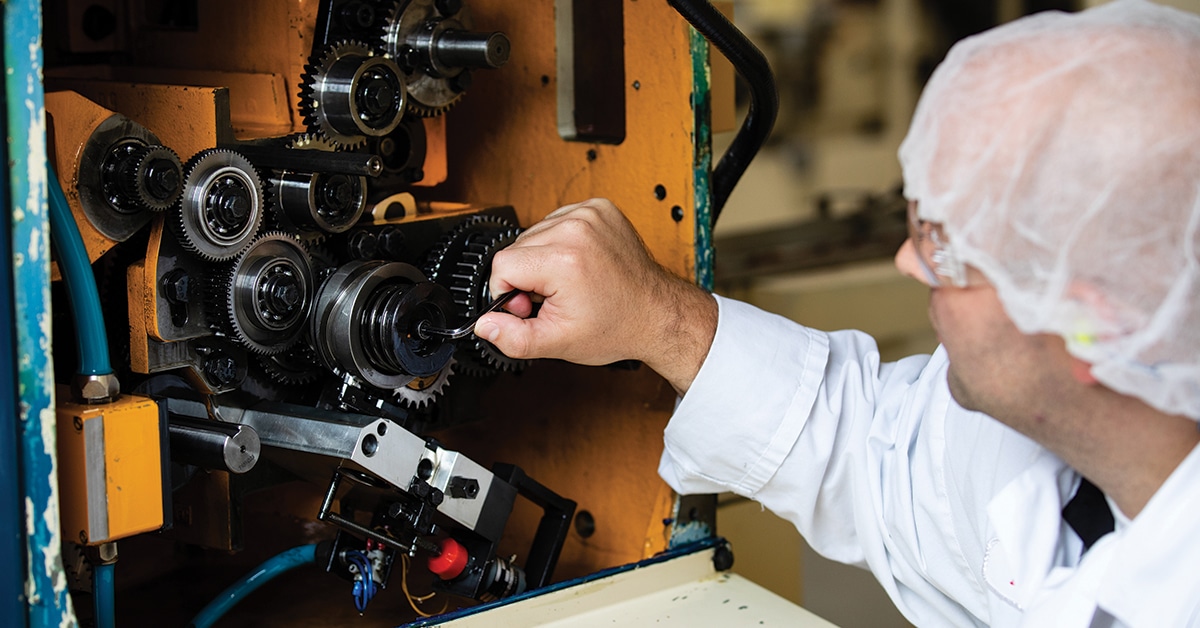




The break-fix cycle remains common across many manufacturing operations. Equipment breaks, maintenance teams respond and businesses do their best to limit unplanned downtime.
Known as breakdown maintenance, this reactive approach persists despite the rise of connected technologies that enable real-time monitoring and predictive maintenance strategies.
Three components underpin the continuing use of this reactive maintenance approach: cost, legacy practices and asset criticality. In some cases, equipment failure is more cost-effective than proactive maintenance. In others, embedded legacy technologies or production line practices make changes difficult and time-consuming. Finally, it may require less time and fewer resources to replace rather than repair non-critical assets.
Ideally, breakdown maintenance is used as one option within a broader maintenance strategy. Here’s what you need to know about when it’s commonly used, what risks it carries and how it can be effectively integrated with other types of maintenance strategies.
What is breakdown maintenance?
Breakdown maintenance is a reactive maintenance strategy in which equipment is repaired only after it fails. As a result, it is also known as “run-to-failure” maintenance. Unlike scheduled and predictive maintenance, most breakdown maintenance is not planned prior to failure. In addition, no interventions are used to lower or limit the risk of failure. Instead, machines are left to run until they break. Some manufacturers use a planned breakdown maintenance approach for assets with predictable failure intervals, which helps limit risk and the time required to source necessary parts.
It is only once breakdowns occur that maintenance begins, and the sole purpose of this maintenance is restoring equipment to operating condition. No steps are made to prevent failure from occurring again; getting machines up and running again ASAP is the only priority.
Common examples of breakdown maintenance
For many assets, breakdown maintenance is more expensive and time-consuming than tracking equipment condition and taking preventive action. There are cases, however, where breakdown maintenance remains common. They include:
- Non-critical or low-cost assets
- Backup or duplicate equipment
- Components with predictable and non-catastrophic failure modes
- Simple systems with minimal impact on safety or production
- Machines with low-cost replacement parts
- Equipment with minimal impact on safety, quality or delivery
- Failure does not cause collateral damage
- Downtime risks are acceptable
- The cost of monitoring exceeds the risk of failure
Risks and limitations of breakdown maintenance
Breakdown maintenance carries inherent risk tied to the connected nature of manufacturing.
For example, consider an aerospace engineering company that makes highly specialized components. For the vast majority of their production processes, the company uses a predictive approach that looks to maximize uptime and minimize disruptions. When it comes to light bulbs, however, breakdown maintenance is more cost-effective. The company does not attempt to proactively replace production line lighting, instead waiting until bulbs burn out.
This proves effective until the simultaneous failure of five high-lumen lights causes a shop-floor collision that leaves two staff members injured and a critical piece of equipment damaged, leading to unexpected downtime and injury costs far higher than predictive maintenance spending.
Unplanned breakdown maintenance also comes with other risks and limitations, such as:
- Production disruptions
- Higher repair and labor costs
- Increased safety risks during emergency maintenance
- Secondary damage to surrounding components
- Lost delivery commitments and reduced customer satisfaction
The impact of breakdown maintenance on operational performance
Breakdown maintenance can negatively impact performance metrics.
One key concern is variability tied to unpredictable schedules and workloads. For example, if low-impact parts begin to fail inside key production line machinery, companies must eventually take the equipment offline and replace these parts. If they are hard to reach or remove, this can lead to extended unplanned downtime.
This sets the stage for lower asset availability and reliability, along with increased overtime for technicians and costs for expedited parts. In the worst-case scenario, taking a breakdown maintenance approach could lead to missed production and delivery targets.
Reducing reliance on breakdown maintenance
While it’s impossible to fully eliminate breakdown maintenance tasks, there are steps that manufacturers can take to reduce their reliance on this approach. They include:
- Identifying high-impact failure modes: Pinpoint failure modes—or causes—that have the highest potential impact on operations, and then connect the dots on maintenance management. Are there breakdown processes that are tied, even tangentially, to these failure modes? Identifying these causes sets the stage for corrective maintenance that limits total risk.
- Introducing basic preventive maintenance: Preventive maintenance programs don’t need to be expensive or time-consuming. Even once-monthly or once-quarterly inspections can help prevent failures and reduce reliance on breakdown practices. Manufacturers can also consider a predictive maintenance pilot program once preventative maintenance plans are up and running.
- Improving asset criticality assessments: The connected nature of manufacturing means that criticality assessments require regular re-evaluation. Assets and processes that were previously low-risk may now be intrinsically tied to higher-impact operations.
- Using data to prioritize reliability improvements: Data drives reliability improvements. This data is often collected by computerized maintenance management systems (CMMS) from connected sensors that help track temperature, vibration, pressure and other condition information that helps anticipate failure. Equipped with this data, manufacturers can create planned maintenance schedules that address common issues.
- Building maintenance planning and scheduling discipline: Better maintenance planning and scheduling discipline make it easier for teams to track and manage breakdown risks. For example, if technicians review non-critical equipment condition once per month, they can compare condition data over time to track patterns and anticipate repair needs.
Shift away from breakdown maintenance for improved reliability
Breakdown maintenance operations are reactive, risk-heavy and lead to unpredictable outcomes. What should be simple and cost-effective repairs can lead to unexpected and expensive downtime, worker injuries and compliance challenges.
Shifting away from breakdown maintenance starts with data: Where are breakdown processes currently being used? What are their potential impacts? How could maintenance activity scheduling and predictive analysis reduce total risk?
Awareness of breakdown processes leads to action, which in turn helps drive improved reliability, maintenance cost control and operational excellence.
Track and manage the maintenance data you need to build proactive processes. See how ATS helps manufacturers reduce downtime and control maintenance costs. Let’s talk.