
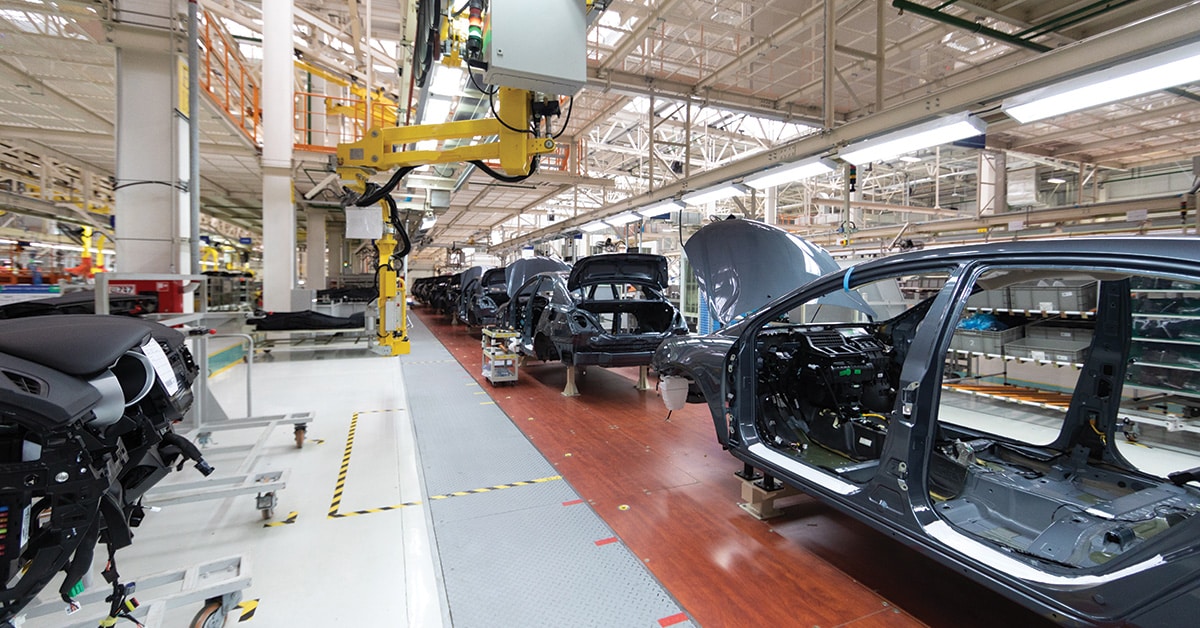




Automotive manufacturing is one of the most demanding production environments in the world. Tight tolerances, high production volumes and strict quality standards leave little room for error. At the same time, manufacturers are under constant pressure to increase throughput, reduce costs and meet evolving customer expectations.
Improving both quality and productivity isn’t just a goal, it’s a competitive necessity. The challenge? These two objectives are deeply connected. Poor quality leads to rework and downtime, while inefficient processes reduce output and strain resources.
In this guide, we will explore how to improve quality in the automotive industry, while supporting productivity through smarter maintenance strategies, process optimization and advanced technologies. The right mix depends on your plant’s equipment, production constraints and current process maturity.
Why quality and productivity are interconnected
Increasing quality within the manufacturing process, by reducing defects and rework, helps work move through the operation with fewer interruptions, supporting more consistent productivity. High-quality work eliminates time-consuming corrections, allowing resources to be utilized more efficiently.
However, in the short term, overemphasizing speed, or productivity, can sacrifice quality, while an excessive focus on perfection, or quality assurance, can hinder output. Therefore, quality and productivity must be balanced.
Common challenges in automotive manufacturing
Automotive manufacturers face many challenges in automotive production. These challenges range from supply chain volatility, the transition to electric vehicles (EVs), and rising material and labor costs. Automotive companies must navigate unplanned equipment downtime, workforce skill gaps, high defect rates, and bottlenecks in production lines.
These challenges are compounded by the rapid increase of technology in the automotive manufacturing process, also known as the digital transformation of automotive manufacturing. As vehicles incorporate more and more digital technology in the production process, the complexity of these changes affects quality control.
Technological complexity is a huge issue in the automotive industry as automotive manufacturers struggle to unite software, sensors, and onboard computers with traditional combustion, hybrid, and electric engine vehicles. In some cases, those systems do not integrate cleanly, which can contribute to quality escapes, rework and costly recalls.
These challenges stem from the delicate balance of quality and productivity. Working with new and inconsistent process controls, quality issues from outsourced parts, rapidly changing electronics, and updating legacy equipment and systems to pair with new technology is a difficult task. The more time an automotive manufacturer takes to work out these compatibility issues, productivity and production suffer.
Improving equipment reliability to boost productivity
To boost productivity in manufacturing, equipment reliability must be improved. Equipment reliability has an influence on production output and productivity. Higher equipment reliability can support more stable operations, lower downtime-related costs, and fewer quality issues caused by equipment drift or failure. Automotive manufacturers that improve equipment reliability will experience increased throughput in production lines, improved productivity and enhanced product quality. One method to increase productivity is by using the Overall Equipment Effectiveness (OEE) metric, which measures manufacturing productivity, equipment reliability and overall quality. By increasing equipment reliability, an organization’s OEE will go up.
A trend in automotive manufacturing has been to use preventive maintenance programs as well to improve equipment reliability. These programs schedule regular cleaning, lubrication, and inspections of machinery to prevent equipment failure and extend asset life. This helps reduce costly repairs, improves equipment reliability and boosts productivity.
Many automotive companies are also using predictive maintenance programs. This solution uses machine health monitoring via artificial intelligence (AI) sensors to constantly analyze real-time equipment data. Using AI in automotive manufacturing can greatly increase quality and productivity by reducing downtime and maintaining equipment according to its own real-world use environment.
Using predictive maintenance to improve quality
Industrial maintenance for automotive manufacturing can influence product quality by helping equipment stay within optimal specifications and by reducing process variation caused by wear or failure. A predictive maintenance program can detect issues before they affect the quality of workpieces and productivity of production lines by using sensors embedded in equipment. These sensors can monitor temperature, vibration, oil levels, and acoustics. Any readings that are inconsistent will alert a technician to perform a repair. Maintaining equipment in consistent operating condition supports quality standards by reducing scrap and rework, helping work move through the process with fewer disruptions.
Optimizing production processes for efficiency
Process improvements in manufacturing drive productivity by eliminating waste, reducing bottlenecks, and optimizing workflows through structured methodologies, such as Lean Manufacturing, Six Sigma, and Kaizen. These continuous improvement methodologies seek to eliminate waste and inefficiencies, while standardizing workflows and improving quality and productivity.
A quality management system can use continuous improvement processes to optimize automotive quality control by implementing small incremental changes over time that return large benefits. Predictive maintenance can help lead a continuous process improvement cycle as data from monitoring equipment can be used to improve efficiency, quality and productivity continually.
Leveraging automation and robotics in automotive manufacturing
Automation can help improve quality and productivity by taking over repetitive tasks that require speed, repeatability or precise positioning. In the right application, it may reduce manual variation, support faster cycle times, and free labor for troubleshooting, quality checks, or other higher-value work.
This consistency and repeatability is what helps improve quality standards and increases productivity. Automotive manufacturers can use automation and robotics in vehicle assembly, chassis welding, paint coating, and metal fabrication to increase speed and productivity, while improving quality and reliability.
Implementing machine vision for quality control
Manufacturers can improve quality management and defect detection by using machine vision. This technology uses imaging-based hardware and software to provide automated inspection, robot guidance, and identification in industrial settings. It enables high-speed, accurate decisions for tasks, such as quality control, quality assurance, measuring dimensions, and defect detection, often using 1D line-scan or 2D/3D cameras.
Real-time defect detection improves quality control and quality assurance by using technology to catch defects humans may have missed. This reduces reliance on manual inspection, improves defect traceability, and frees workers for higher value tasks.
Is your organization facing quality issues or production inefficiencies? Are you an automotive manufacturer struggling with the digital transformation of automotive manufacturing? ATS can help with quality control, production efficiency and technician training. Talk to an ATS expert about optimizing your operations.
Support workforce training & efficiency
Workforce capability, or the collective skills, knowledge, and behaviors of employees, directly drives organizational results by improving productivity, enhancing quality, and enabling strategic execution. A highly capable workforce will enable faster innovation, higher quality product output, and transform strategic goals from wish lists into actionable outcomes.
To improve workforce capability requires training and retraining employees on new equipment, processes and procedures. Improving communication between teams through cross-training and cross-collaboration will also increase workforce capability. Many organizations find the use of standard operating procedures (SOPs) to be extremely helpful in bringing new employees up to speed on equipment procedures. The more capable a workforce becomes, the more it will develop high-quality products and increase its productivity.
Reducing bottlenecks in automotive production lines
Bottlenecks reduce productivity in automotive manufacturing by restricting workflow, creating backlogs, and causing idle time. These constraints limit overall production capacity, directly leading to increased operational costs, missed deadlines, reduced productivity, and lost profitability. Bottlenecks also strain customer satisfaction through delays and negatively impact employee morale. Automotive companies can use bottleneck analysis from sensors embedded in production lines to alert operators to slowdowns and halts in production. This can help improve production lines and identify line productivity constraints.
Using data and analytics to drive continuous improvement
Data improves decision-making by replacing intuition with facts, leading to greater accuracy, speed, and reduced risk. By analyzing historical data, identifying trends, and forecasting future scenarios, organizations can optimize operational efficiency, enhance customer experiences, and achieve a stronger bottom line.
Using data from real-time AI sensors monitoring production lines can help inform and improve equipment maintenance, production line decisions, and supply chain forecasting. Many organization find tracking specific metrics such as key performance indicators (KPIs) and OEE tracking is helpful in driving a continuous improvement culture in operations.
Where improvements deliver the most impact
High-volume production facilities will find predictive maintenance programs will deliver the fastest results for better equipment reliability, reduced costly repairs, and better-quality end products. A continuous process improvement methodology, such as Lean Manufacturing, will help manufacturers improve over the long term by making small changes each day that lead to higher quality standards and better operational efficiency.
This will help lead the digital transformation of automotive manufacturing as the industry shifts to more efficient assembly lines, demands higher quality Tier 1 and Tier 2 suppliers of technologically complex components, and replaces plants with aging equipment.
Driving performance through quality and efficiency
Quality and productivity are tightly linked together and must equally balance each other. By optimizing processes, fostering a continuous improvement culture, and using data analytics to inform better decision-making automotive manufacturers can improve product quality, consistency, and productivity.
Manufacturers don’t need to implement these changes alone. This is where ATS can help. We can partner with you and provide reliability-centered maintenance programs that will improve equipment uptime, reduce costs, increase productivity, and enhance product quality. We offer comprehensive equipment monitoring, analytics, and workforce training. Contact us today to learn more.
