
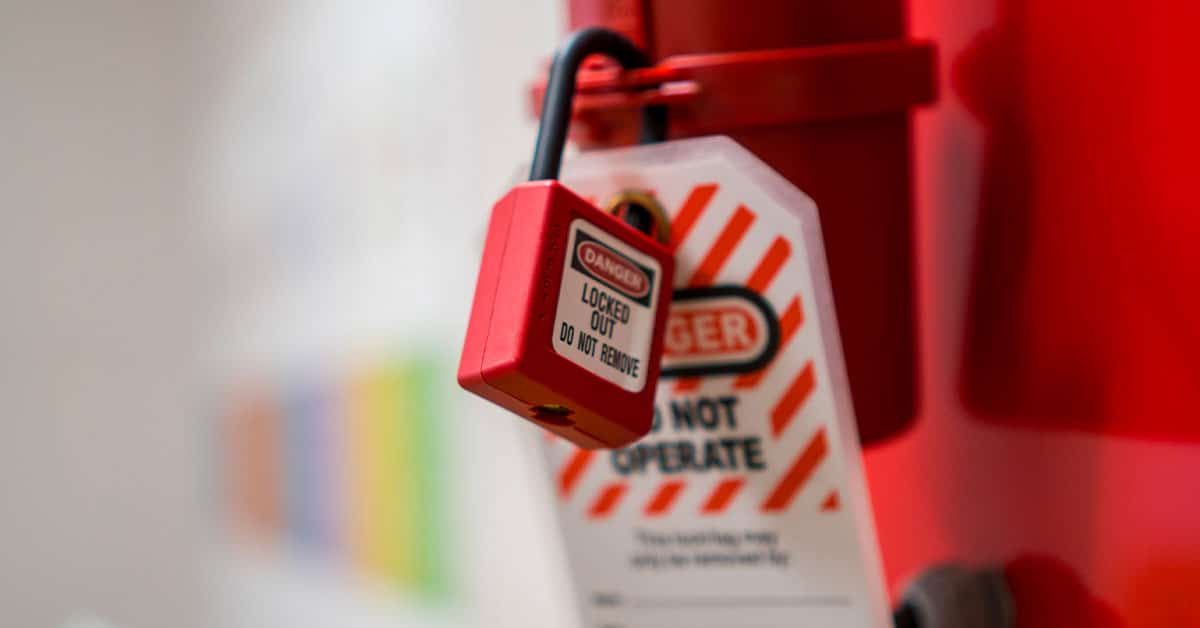




What is lockout/tagout? In manufacturing and industrial maintenance, it is a safety measure designed to prevent equipment from being powered on while an employee is in a potentially hazardous position or location, such as cleaning the machine or performing repairs on it.
Lockout/tagout (LOTO) can work in either of the two ways described in its name:
- Lockout: Equipment or components are physically locked to prevent inadvertent operation. This can be in the form of a lock and key, or another device that may, for instance, prevent a switch from being turned on.
- Tagout: A visual indicator is applied to equipment to show that it should not be operated, and that doing so will place an employee in danger. This indicator may be in the form of a brightly colored tag, a sign, a symbol or some other approved method.
These two methods can be used in conjunction, and industrial technology is delivering newer methods of achieving these results, such as digital lockouts or shutdowns. Lockout/tagout is a critical part of any industrial safety plan and is in fact an OSHA requirement. Failing to follow such LOTO protocols can lead to significant risks on the jobsite including injuries and regulatory penalties. Read on to learn more about lockout/tagout best practices, procedures and steps.
What is LOTO procedure?
Lockout/tagout procedures must be clearly documented in order to be effective—and also to comply with OSHA guidelines. OSHA defines the requirement for lockout/tagout as the need to control hazardous energy, which helps to account not only for accidental startup, but also to account for stored energy that can harm workers either directly or indirectly.
OSHA defines energy sources as, at a minimum, electrical, mechanical, hydraulic, pneumatic, chemical and thermal energy, along with any other potential energy sources. There are numerous OSHA regulations that cover lockout/tagout, with the primary regulation being CFR 1910.147.
OSHA lockout/tagout procedure includes a rigorous training requirement for all employees to ensure that they understand the purpose of LOTO, the potential repercussions of non-compliance, and the proper steps and methods that should be followed. Employees must also regularly be retrained to maintain knowledge and best practices.
Lockout/tagout is required by OSHA standards as a response to the very real dangers that industrial workers face every day—dangers that can and have resulted in serious injury and death. Accidental startup or energy release can result in electrocution, burns, crushing injuries, damage to limbs and more. It is critical to follow the proper lockout/tagout steps to reduce the chances of these scenarios occurring.
The 7 steps of LOTO
1. Preparation: During this stage, an authorized employee must identify the need for shutdown as well as any potential sources of excess power. While this information should be documented as part of an SOP, the employee is responsible to ensure that all potential sources of power will be accounted for. This step also includes identifying a strategy to dissipate excess energy and control any further flow of energy.
2. Notify employees: Following the initial preparation step, all employees who may interact with the equipment must be notified of the impending shutdown, and that the equipment is not to be used or operated until further notice. This step may involve notifying employees who are not on-site or at work at the time, so it is critical to have a comprehensive notification plan in place.
3. Shutdown: If the equipment is currently operating, it should be shut down at this time via standard procedures. Standard shutdown is a key step in providing repeatability and consistency for the subsequent steps, which are critical for safe, effective LOTO.
4. Isolation: At this point, the equipment should be isolated from any potential sources of power or energy. This is often more complex than simply unplugging a machine—in order to ensure safety and compliance, the isolation step will often involve powering down at a breaker, or a similar process. This helps to control power and ensure total isolation from any power source.
5. Drain remaining energy: The method to drain any remaining energy should be identified during the preparation stage. Once the equipment has been isolated from all power sources, the authorized employee must further ensure that any remaining energy within the equipment is dissipated, bled or drained. This step helps to prevent incidents like accidental electrical shock, burns from buildup of steam and other unexpected, dangerous scenarios.
6. Apply lockout/tagout: Here, the lockout/tagout is applied in whatever form has been approved for the equipment and the scenario. It is critical that employees have their own tool (such as their own lock) to ensure traceability and accountability. It is also helpful to include employee names and contact information on locks and tags, again, for accountability and tracking.
7. Isolation verification: Before work is started, the authorized employee must verify isolation in a safe, approved manner. This step typically involves following standard startup procedure to ensure that the equipment will not, in fact, start while isolated, but may involve other steps as well, depending on the equipment in use.
Looking to standardize and improve your safety procedures?
Why lockout/tagout procedures are critical for industrial safety
Adhering to lockout/tagout procedures is critical for reducing risk exposure and liability. That’s because they help prevent common incidents such as accidental startup of equipment or an intended release of stored energy. These incidents can result in serious injuries as well as OSHA fines and other regulatory consequences.
How to ensure OSHA compliance with LOTO
Compliance with OSHA requirements calls for written SOP, comprehensive employee training and certification, proper documentation, equipment-specific procedures, and periodic audits. Use a checklist during audits to ensure all required steps are completed and applied consistently.
Audit checklist
- Are all energy sources identified?
- Are procedures documented?
- Are employees trained and certified?
- Are audits conducted regularly?
- Are locks/tags standardized?
- Are isolation verification procedures performed consistently?
Take the next step toward safer operations
The importance of safety in the workplace cannot be overstated. LOTO is a critical and necessary safety practice, and one that every manufacturer must have in place in order to keep employees safe and to comply with OSHA requirements. Failure to do so can result in fines, as well as grave danger to workers. Consider these points when developing a LOTO process of your own to ensure success. Let ATS evaluate your current procedures and identify gaps. To get started, click here.