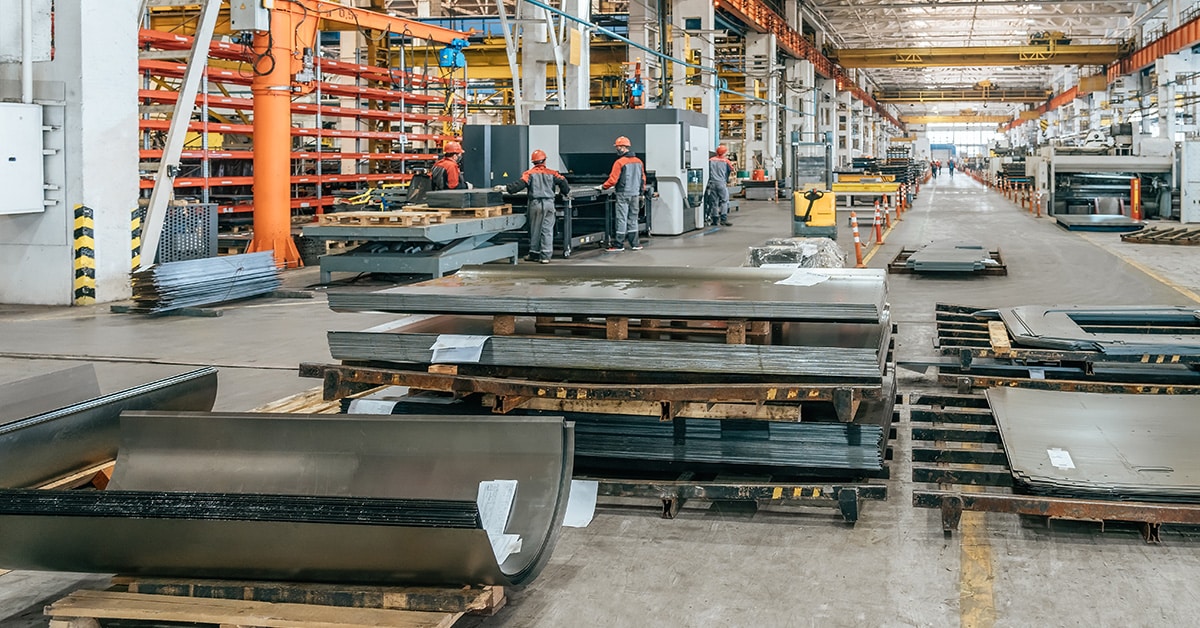




Those pallets of material, racks of subassemblies and totes of parts filling the manufacturing floor are all Work in Process inventory. Usually shortened to WIP inventory, and sometimes erroneously called Work in Progress inventory, WIP can cover up bottlenecks and cause any number of problems. And yet, in the financial accounts it’s listed as an asset.
Business controllers need to value WIP, which is not straightforward. Unlike raw material and finished goods inventory, WIP can’t readily be sold because it’s unfinished, yet it has incurred manufacturing cost and, in accounting terms, it has value.
Physical rather than book value WIP can be thought of as queues of material awaiting processing. Without WIP, machines and production lines would be idle because they’d have nothing to work on. In this sense, WIP is essential for operational efficiency, but if the WIP level gets too high, inefficiencies and waste creep in.
This blog sets out to explain what WIP is, why it’s needed and the problems of excessive WIP. It covers the components of WIP, ways of managing WIP inventory and WIP as a KPI. Additionally, it discusses the critical role maintenance plays in optimizing WIP.
Key components of WIP
Factories hold raw materials, which can include purchased components and subassemblies, in inventory before releasing them to manufacturing. Once they hit the factory floor, they are machined, formed, assembled and processed into products that customers want to buy. Then, when complete, they are moved into the finished goods warehouse, ready for shipping.
The intermediate state, between raw materials and finished goods, is termed Work in Process (WIP). WIP is material where some work has been performed, but the raw materials have not yet become finished products. (Note that the term “Work in Progress” applies to large, long-duration projects, like bridge and tunnel construction.)
The total manufacturing cost of WIP is calculated by adding the cost of materials, direct labor, and manufacturing overhead required to bring it to its current state of completion. As WIP advances through the production process, its value increases accordingly.
How to calculate WIP inventory
For a business controller to value WIP inventory precisely, they would need a snapshot showing the quantities of material at each step of the production process. They would then arrive at a total value by adding the cumulative overhead and direct labor costs incurred at each of those steps to the cost of raw materials used.
Historically, overhead costs were typically calculated as a percentage of direct labor. However, in modern factories, automation means direct labor is a small part of total manufacturing costs and labor percentages can lead to overhead allocation problems. Consequently, the method many manufacturers use today is to allocate overheads based on an equipment-related metric such as square footage occupied.
Regardless of which overhead allocation method is used, calculating WIP inventory from these first principles is cumbersome. A more common approach is to look at how the level of WIP inventory has changed from one accounting period to the next. The formula for this is:
Opening WIP + Manufacturing Costs – Cost of Goods Manufactured = Closing WIP
(In this equation, Cost of Goods Manufactured is the value of product moved into finished goods inventory prior to being sold.)
In the accounting system, WIP is listed as an asset, along with raw materials and manufactured goods. WIP inventory management helps manufacturers manage budgets, plan resources and meet accounting compliance standards.
Why managing WIP matters
WIP levels have implications for both cash flow and operational efficiency.
Taking the financial perspective first, WIP represents production cost incurred but not yet recovered from the customer. If the WIP level in a factory rises over time, that implies the business is spending more than it earns, so cash flow is negative. This takes money away from other activities, such as R&D, and is usually a drain on resources.
Conversely, when managers are able to reduce WIP, one result is positive cash flow.
In operational terms, WIP is essential for efficiency. When there’s no material available for processing, lines and machines stand idle and the overhead costs allocated to them are not being recovered.
However, excessive WIP also causes problems. These stem in part from the space it takes up and the need to move it. Bigger issues though are the impact of WIP on factory throughput efficiency and quality.
Throughput refers to the rate at which product moves through a factory, from raw materials to finished goods inventory. It’s very closely related to manufacturing lead time. Within the factory, every piece of equipment has a maximum capacity or rate at which it can run. Without increasing capacity, adding more material to the factory floor creates longer queues at each machine, which in turn extends lead times.
Looking at a sequence of manufacturing operations, typically one step has the least capacity. This becomes a bottleneck that limits output from that line or cell. Bottleneck operations can sometimes be recognized by the build-up of WIP prior to the operation, and the scarcity of it afterward.
The relationship between WIP and quality has two components. First, when quality levels are low and scrap rates are high, more material is released into the factory to account for losses through production. If those losses exceed the predicted level, the order may be short and a second production order needed.
In addition, when WIP levels are high, any quality issue, such as a process being set to the wrong temperature, can result in a larger volume of defective products that will need to be reviewed. This incurs time and cost that are not included in the original product cost.
WIP management is closely tied to production scheduling and machine availability. While there is an optimal level of WIP for maximizing operational efficiency, the challenge is to determine what that is. s emerging during the process.
Strategies to reduce excess WIP
High levels of WIP show up as long throughput times coupled with large quantities of bins, pallets, and racks on the plant floor. In addition, the business controller will be concerned about cash flow and the capital tied up in part finished products.
Given that managers want to reduce WIP to the lowest levels possible without adversely affecting efficiency and output, what approaches exist?
The answer for most businesses is to implement Lean manufacturing and just-in-time (JIT) production methods. This is best done in conjunction with lean maintenance techniques and ERP systems for real-time inventory tracking.
Lean manufacturing seeks to eliminate waste, which includes WIP inventory. A core part of Lean is to simplify and allow goods and material to flow through the factory. This involves standardizing workflows and improving floor layout to reduce movement.
Where appropriate, especially in batch manufacturing environments, efforts should be made to reduce machine set-up time, by applying Single Minute Exchange of Dies (SMED) concepts. This increases capacity, so is often performed on bottleneck equipment. A common side benefit of SMED is to reduce part-to-part variability.
JIT is often seen as a supply chain strategy for delivering finished goods, especially in the automotive industry, but it can also be used between production departments. It’s achieved by implementing pull systems, as opposed to “push” methods that were widely used in the past.
Pull systems use a signal or kanban for the downstream department to indicate when more material or WIP is needed. WIP manufacturing is tightly constrained by enforcing a rule that a department cannot produce without a kanban signal.
Lean maintenance shares the waste-elimination mindset of Lean manufacturing, but with a focus on maximizing maintenance activities. For WIP reduction, maintenance should focus on the bottleneck operation or process. Maximizing availability and uptime here increases system capacity, raising throughput and shrinking lead time.
Preventive maintenance is important throughout manufacturing, but particularly at bottlenecks, predictive maintenance is a more effective strategy for reducing WIP. Predictive maintenance minimizes both planned and unplanned downtime by ensuring work is deferred as long as possible and scheduled for the least disruptive time.
ERP’s role in WIP reduction is to schedule production, track inventory as it flows through the factory in real time and enhance visibility and control. ERP is used to measure and value WIP, which supports bottleneck identification and capacity planning. Used with pull systems, ERP helps manufacturers keep processes running efficiently while still minimizing WIP.
Role of technology in WIP management
Pull systems and kanban have helped manufacturers drive down WIP levels, but the need to improve never goes away. Today, digital transformation, or Industry 4.0 technologies, overlaid on Lean manufacturing, offer the next advance.
In the maintenance arena digital transformation refers to machine health monitoring systems and predictive maintenance solutions. Machine health monitoring involves instrumenting equipment with Industrial Internet of Things (IIoT) devices. These sense relevant physical properties and operating conditions, like speed, current draw, temperature and vibration, and share these, sometimes after some signal processing, with a predictive maintenance package.
This monitors trends to extrapolate failure risks (and is a growing application of AI). As the probability of a breakdown or other problems grows, the predictive maintenance tools work with the CMMS to raise and schedule work orders. This avoids taking equipment out of service for planned maintenance work that may be unnecessary, so helping raise OEE while reducing maintenance costs. It’s especially beneficial at bottleneck processes.
Two more technologies for supporting WIP reduction efforts are digital twins and AI. A digital twin is a virtual recreation of the manufacturing plant that operates just like the plant and produces the same outputs (in virtual form) in response to given inputs. A digital twin can be used to perform experiments without risking disruption to actual production and customer orders. For example, it can be used to evaluate the impact of different production schedules on WIP, throughput, and other metrics.
AI is finding many roles in manufacturing, but one with significant WIP reduction potential is forecasting. With long supply chains, many manufacturers can’t wait for customer orders and instead release orders into the factory based on forecasts. AI can potentially improve forecasting, which will help with optimizing production schedules and managing bottlenecks.
WIP in different types of manufacturing
WIP strategies vary by industry depending on product complexity, production stages and storage needs.
In discrete manufacturing, as seen in automotive, electronics and most industrial and consumer products, WIP is visible throughout a factory. It’s in boxes and bins, hanging from racks and stacked on pallets, and individual units are tracked through the ERP system.
Automated discrete manufacturing lines, where machines and processes are linked by conveyors, naturally constrain WIP. In batch manufacturing, cells and kanban are widely used to regulate WIP levels.
WIP in process manufacturing is constrained in much the same way as on automated production lines. Pipes, tanks and other vessels limit the amount of material present throughout the process, and the only way to increase WIP is to divert fluids into holding tanks (which might be done to allow for maintenance). WIP in process industries is usually tracked at the batch level or in terms of quantity produced.
Final thoughts: WIP as a KPI
Measuring WIP has benefits beyond providing a number for monthly accounts. If used as a KPI, it enables:
- Measurement of process efficiency: High WIP, especially if the trend is rising, signals problems in the plant. Typically, these will be bottlenecks and machine downtime, although it could also be an indicator of issues with how work is scheduled.
- Identification of excess costs: WIP incurs storage and handling costs, and if it deteriorates as some materials do, it could require financial write-offs. By tracking WIP levels, management can identify when problems are occurring.
- Tracking of production planning and scheduling performance: Problems with forecasting, planning and scheduling often show up as increases in WIP. This happens when one order or batch is halted, so the plant can prioritize another order that is more urgently needed.
In summary, while WIP is essential, too much increases production costs and reduces efficiency. Regular monitoring helps gauge production health, efficiency and waste, and allows for proactive adjustments in scheduling, procurement and workforce planning. Reducing WIP levels leads to faster throughput, shorter lead times and thus higher customer satisfaction.