




Automation is essential for manufacturers aiming to build smart factories and enable digital-first production lines.
Gartner reports that advanced automation ranks among the top-three priorities for business leaders. The challenge? Two-thirds of organizations “are not pursuing the needed aggressive redesign of manufacturing operations to deliver on expectations for advanced automation.”
ISA-95, also known as IEC 62264 or ANSI/ISA-95, can help improve the integration, deployment and management of automation technologies. Here’s how.
What is ISA-95?
ISA-95 is published and maintained by the International Society of Automation (ISA). Based on the Purdue Enterprise Reference Architecture (PERA), this ISA standard was developed in the 1990s and released in the early part of the 21st century as ISA-95 Part 1, the foundation of several ISA-95 parts that expand on integration principles.
Per the official ISA website, ISA-95 is “an international set of standards aimed at integrating logistics systems with manufacturing control systems.” Today, more than 90% of manufacturers use ISA-95 to improve automation.
The primary goal of ISA-95 is to ensure that different systems and software speak the same language. This enables real-time visibility into production, assets and workforce activity, and it helps manufacturers scale operations consistently across both plants and regions.
The ISA-95 five-level model for manufacturing
ISA-95 uses a five-level model, often represented as a pyramid, to help connect ERP, CRM and SCM systems with shop-floor processes.
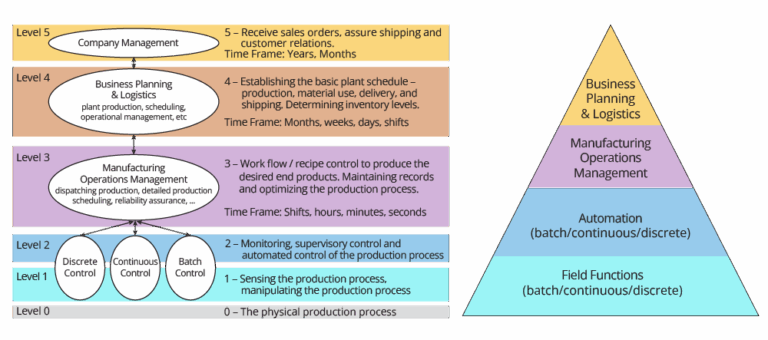
Source: International Society of Automation
Here’s a look at the different levels in more detail:
- Level 0 — Physical production processes: Level 0 covers the processes that take place on shop floors and production lines, and are performed by machinery, robots or other equipment.
- Level 1 — Sensing and manipulating the production process: Level 1 relies on sensors, actuators and programmable logic controllers (PLCs) to collect real-time performance measurements and make adjustments as needed.
- Level 2 — Monitoring and supervising control: Level 2 uses tools such as SCADA systems and human-machine interfaces (HMIs) to control machines and respond to alerts or alarms.
- Level 3 — Manufacturing operations management: Level 3 prioritizes the development of production schedules along with maintenance execution. Common tools include manufacturing execution systems (MES) and computerized manufacturing management systems (CMMS).
- Level 4 — Business planning and logistics: Finally, Level 4 uses CRM, SCM and ERP software to drive business planning across forecasting and order demand.
As the official ISA diagram indicates, there’s also a level 5, which represents company management. Functions of this level include receiving sales orders and improving customer relationships.
Level | Focus | Typical systems | Example outputs |
Level 0 | Physical production | Machines, robotics, labor | Raw sensor data |
Level 1 | Sensing and manipulation | Sensors, actuators, PLCs | Real-time measurements |
Level 2 | Monitoring and control | SCADA, HMIs, DCS | Machine control and alarms |
Level 3 | Manufacturing operations | MES, CMMS, APS | Production schedules, maintenance execution |
Level 4 | Business planning | ERP, SCM, CRM | Forecasting, order demand |
Key components and models of ISA-95
ISA-95 is comprised of three foundational models: activity models, object models and information models.
Activity Models
Activity models define roles, activities and interactions across data and process silos. In other words, activity models assign jobs or tasks and determine how assets will interact across different ISA-95 levels to accomplish desired outcomes. For example, an MES system might automatically trigger maintenance requests based on asset data.
Object Models
Object models standardize definitions to create a common language. Common areas of standardization include equipment, materials and personnel.
Information Models
Information exchange models handle data flows, security and access rules. These models help improve traceability, scheduling precision, quality control and industrial maintenance management. In practice, this could mean ERP systems automatically update as materials move through production.
ISA-95 and MES integration
Manufacturing execution systems (MES) occupy Level 3 of the ISA-95 framework. By applying ISA-95 standards, companies can ensure well-defined communication between MES and ERP tools.
Integrating MES with ISA-95 offers multiple benefits, such as:
- Work order automation
- Reduction of manual input delays and errors
- Real-time performance dashboards
- Predictive maintenance readiness
- More accurate costing and capacity planning
ISA-95 vs. other standards
ISA-95 is often used in conjunction with other standards, such as ISA-88 and ISA-99.
ISA-88 was developed before ISA-95 and focuses on the physical processes of manufacturing, or the first three layers of the ISA-95 standard. The standards both use a pyramid-shaped model to differentiate layers, and ISA-95 borrowed much of ISA-88’s terminology. Put simply, ISA-95 uses and expands on the framework of ISA-88.
ISA-99, meanwhile, provides a standardized security framework for industrial automation and control systems (IACS). By protecting these systems, ISA-99 helps enterprises reduce the risk of malicious attacks and sudden downtime.
In tandem with ISA-95, ISA-99 and ISA-88 help bolster security and streamline processes. ISA-95, however, remains the gold standard in supporting manufacturing efficiency and enterprise control system integration. This is because of its focus on a common language. Unlike ISA-88, which prioritizes physical production processes, or ISA-99, which targets digital defense, ISA-95 ensures that all enterprise systems—from shop-floor equipment to MES and ERP—can easily communicate.
The role of ISA-95 in Industry 4.0 and IIoT
As manufacturing trends like Industry 4.0 drive the development of smart factories underpinned by sensors across the Industrial Internet of Things (IIoT), companies can’t afford issues with communication and connection.
Ensuring ISA-95 alignment supports Industry 4.0 initiatives, such as:
- Deployment of cyber-physical systems: Smart production lines now connect digital and physical systems. For example, an automaker might leverage AI frameworks to inform the behavior of stationary robotic arms used to assemble car parts. For these systems to work in tandem, they need to speak the same language; the ISA-95 model makes this possible.
- Visibility from edge to enterprise: While many manufacturers leverage the cloud, they now recognize the growing need for edge-based systems that can handle data exchange and processing closer to data sources. ISA-95 helps enable visibility across predictive maintenance processes, smart sensor deployment and digital twin integration.
- Integration with future technologies: As manufacturers integrate solutions such as container-based applications, microservices and more advanced AI tools, they don’t want to rebuild data architecture. Not only is this process time-consuming but also it can introduce the potential for interoperability errors. ISA-95 provides a common framework that allows companies to connect future tech quickly and easily.
ISA-95 compliance benefits and business outcomes
By implementing ISA-95, companies are better prepared to navigate evolving regulatory expectations and drive better business outcomes. Some tangible benefits include:
- Faster implementation of automation upgrades
- Lower integration costs and risks
- Stronger OEE and throughput visibility
- Improved data-driven decision making
- Inventory and supply chain synchronization
- Regulatory and compliance traceability
- CMMS + MES + ERP synergy to optimize uptime and resource allocation
Challenges and implementation considerations
Given the scope of ISA-95 deployments, manufacturers often encounter challenges in implementation and management.
First is legacy infrastructure complexity. Older infrastructure may not be designed for always-on connections and may struggle with interoperability. As a result, it’s critical to start with an infrastructure assessment: Determine what you have, how it works and what needs to change.
Next are issues around data cleansing and classification. For ISA-95 standards to work, companies need clean and usable data. Here, it’s often worth partnering with a third-party provider who can help identify data issues and suggest targeted resolutions.
Workforce training and change management are also challenging. Without training, employees won’t have the skills and knowledge necessary to manage the deployment of digital systems and connect them to ISA-95 expectations. As a result, both initial and ongoing training are necessary to eliminate potential friction points.
Finally, deployment can prove problematic. To minimize potential issues, take a phased rollout approach. Common phrases include:
- Phase 1: Integration assessment
- Phase 2: Data standardization
- Phase 3: System connectivity
- Phase 4: Optimization and analytics
Depending on the complexity of your manufacturing infrastructure and your available budget, ISA-95 implementation can take anywhere from one to six months. It’s also worth noting that ISA-95 alignment is an ongoing process. Standards, expectations and outputs should be regularly reviewed to ensure manufacturing realities meet ISA-95 expectations.
Where to begin: Expert support for ISA-95 alignment
Given the comprehensive and interconnected nature of ISA-95 with manufacturing systems, companies can benefit from expert assistance to ensure alignment.
For example, experienced providers can examine your system as a whole and develop end-to-end strategies that reduce the risk of roadblocks and help accelerate outcomes. They can also assess the maturity of current manufacturing systems and suggest necessary upgrades or improvements. Finally, outsourced partners can help create roadmaps for interoperability and modernization that go beyond initial deployments to support manufacturers over the long term.
References
Gartner, Inc. (2025, October 28). Gartner survey shows 49 percent of organizations lack confidence in future manufacturing strategy. Gartner Newsroom.
https://www.gartner.com/en/newsroom/press-releases/2025-10-28-gartner-survey-shows-49-percent-of-organizations-lack-confidence-in-future-manufacturing-strategy
International Society of Automation. (n.d.). ISA-95 series of standards: Enterprise-control system integration. ISA. https://www.isa.org/standards-and-publications/isa-standards/isa-95-standard
Winter, J. (2025, May 27). How well is ISA-95 adopted? Jeff Winter Insights.
https://www.jeffwinterinsights.com/insights/isa-95-adoption-levels-2025