
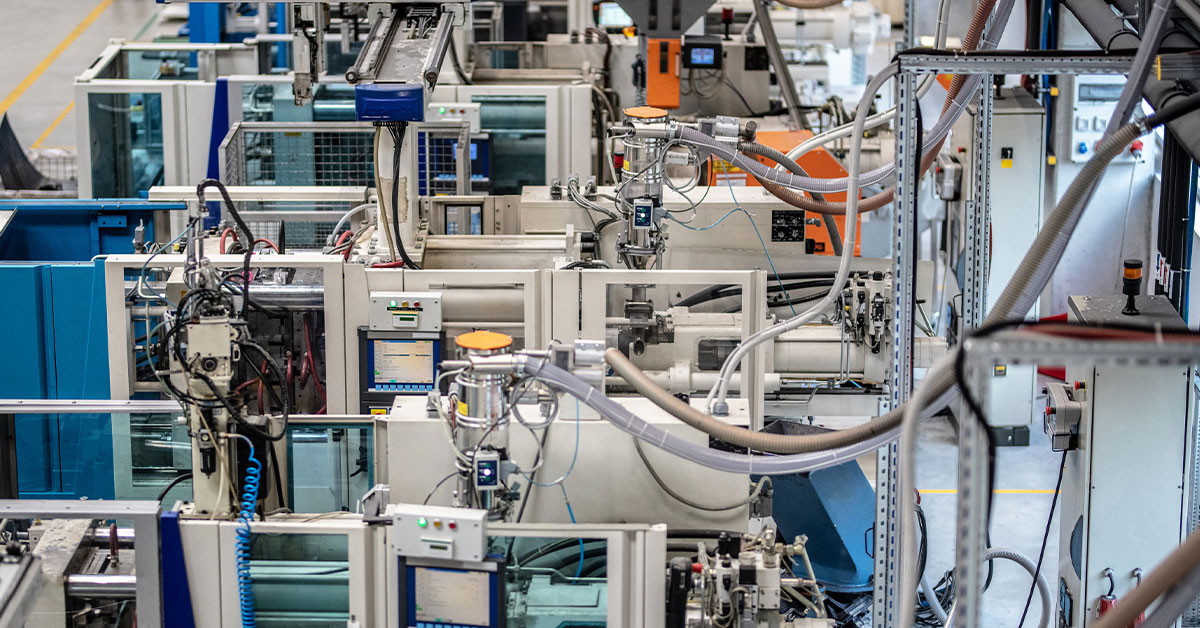




Programmable logic controllers (PLCs) form an integral part of manufacturing automation. These tools have long provided the backbone of industrial automation and are becoming even more effective as industrial technology advances and IIoT (Industrial Internet of Things) takes hold. They serve important roles in controlling machinery and production lines, making them foundational for digital transformation.
Modular PLCs serve as the bridge between condition monitoring sensors and actionable control, integrating with SCADA, MES, ERP, and IIoT platforms. Capable of supporting real-time decisioning, they help prevent downtime and improve OEE. The importance of modern PLCs in the modern manufacturing environment is underscored by how the data they provide informs predictive maintenance activities, which makes them critical for enhancing equipment availability and performance.
What is a Programmable Logic Controller (PLC)?
What is a PLC in manufacturing? A PLC can be thought of as a simple yet powerful type of computer with a set of inputs and outputs. The PLC is programmed with a set of rules, which make up the logic of the controller. As information is received from the inputs, the PLC compares this data against its logic rules and delivers output accordingly.
Through this methodology, PLCs can provide extremely effective automation, controlling manufacturing processes and functions based on real-time information without the need for manual control. Indeed, PLCs form the backbone of nearly all automation processes in manufacturing to this day, and they continue to grow more powerful as the surrounding industrial technology evolves.
They also are designed for use in harsh environments, ensuring their durability and reliability in manufacturing applications. This means operators can depend on them to provide deterministic processing and real-time responsiveness to support machine-level automation even under rough conditions.
How a PLC works
In order to understand how a programmable logic controller works, it is important to know where the inputs described above come from, and what types of outputs can be delivered.
Inputs can consist of nearly any measurable condition of a piece of equipment, such as valves, switches, monitors and sensors. For example, the input may detect whether a switch is in an on or off position, whether a temperature monitor is above or below a certain measurement, or whether a valve is indicating a certain flow rate.
As the input is detected from the control or sensor, the PLC compares information against the programmed logic. While PLCs themselves differ from traditional computers in that they do not have keyboards or screens of their own, they are typically programmed through a desktop application and then applied to the manufacturing application in use. Some of the most common communication protocols used by PLCs include Modbus, Ethernet/IP and Profibus. The purpose of a PLC tool remains critical.
Outputs occur when input conditions trigger an action based on the PLC programming. For example, in an application where material must be mixed, a PLC can stop the delivery of a material once a certain weight or volume is detected—or the PLC in manufacturing can close a valve when a problematic flow rate is detected. In this way, a PLC in manufacturing can not only assist in creating speed, accuracy and efficiency in processes, it can also help to stop potential problems before they start.
Components of a PLC
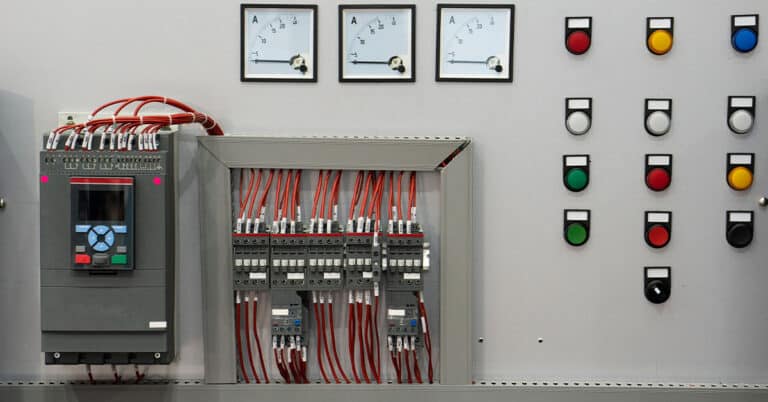
A typical PLC consists of three primary components: the input, the controller and the output. Inputs can be digital or analog—digital inputs provide a binary “on/off” or “yes/no” type return, while analog inputs can accept measurements on a scale.
The controller is programmed via a desktop application and determines the logic by which the PLC will act. Components commonly found in PLCs include:
- CPU (controller)
- Power supply
- Input modules
- Output modules
- Communication modules
- Analog vs digital I/O
- Remote I/O
- HMI integration
- Networking capabilities
- Safety-rated PLCs
The PLC outputs are connected to the device or control on which the PLC will act when its logic dictates. It is possible for the same machine to be connected as an input and an output, for example, for automatic shutoffs when a problem condition is detected.
Benefits of using Programmable Logic Controllers
Programmable logic controllers offer numerous benefits in manufacturing and maintenance:
- Ease of use: PLCs are considered easy to set up and use.
- Low barrier of entry: In addition to the ease of setup, PLCs are also relatively inexpensive, meaning that they can be used to quickly set up an automation implementation with relatively little investment.
- Versatility: PLCs can be used with nearly any piece of industrial equipment and can be used to control a broad range of functionality.
- Problem prevention: By setting up fail-safes and automatic shutoffs in problem scenarios, PLCs can help prevent further damage to equipment.
Uses for PLCs
PLCs offer a broad range of uses and applications across industries, including aerospace, automotive, building products, consumer packaged goods, heavy equipment, metal products, paper and pulp, pharmaceutical and medical devices, power distribution, tire and rubber.
Uses of PLCs may include:
- Mixing and measurement: Mixing is a key process in numerous industries, including food, pharma and construction. PLCs can be used to accurately control volumes and ratios of components.
- Maintenance alerts: PLC systems can detect temperature, flow rates, vibration and other performance data provided by industrial sensors. They can then send a maintenance alert or shut equipment down when potential failure scenarios are detected, which can help support a predictive maintenance approach.
PLCs vs. PACs and modern process control systems
Programmable Action Controllers (PACs) are an alternative to PLCs commonly used in large-scale automation architectures where greater computing power and broad system integration are required.
PLCs, by contrast, deliver the deterministic performance and real-time responsiveness needed for machine-level control. While typically more cost-effective than PACs, they are optimized for precision rather than managing complex, facility-wide systems.
In modern manufacturing environments, both technologies are often used together, combining reliable machine-level control with scalable, plant-wide integration. As their capabilities continue to advance, PLCs and PACs remain foundational to building automation architectures that support reliability, flexibility and long-term operational performance.
PLC maintenance
PLCs are relatively easy to maintain, but the following processes should be followed in order to ensure the continued quality operation of the PLC for automation:
- Routine cleaning: PLCs should be cleaned along with other equipment and components at the start and end of each shift, to ensure that readings are accurate and that the controller can function as intended.
- Good data hygiene: PLC data should be collected, organized and periodically reviewed in order to gain insight into equipment performance and operational trends.
- Check components: PLCs should be part of a preventive maintenance plan and should be regularly checked for damage or wear and tear and replaced as needed. PLCs are also subject to industrial parts repair like other industrial components, and can be sent out for routine expert maintenance.
With this understanding of PLCs, you are ready to implement your own automation system, with the knowledge of how to set up, implement and maintain these powerful tools.