
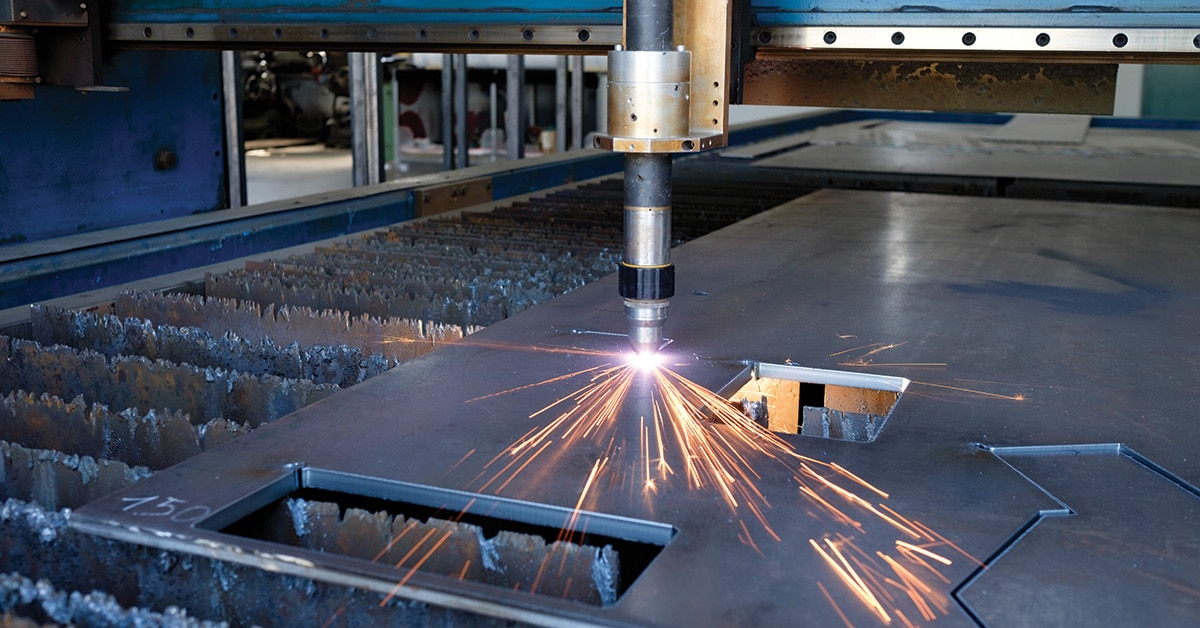




Industrial plasma cutters deliver high-speed, precision cutting for fabrication and manufacturing. An alternative to oxyfuel-based cutters, plasma tools can cut through any conductive material with reduced heat distortion and without the need for flammable gas cylinders.
Like any industrial equipment, however, proper maintenance is key to ensure plasma cutters deliver clean and consistent cuts. Without routine inspection and preventive maintenance, cut quality goes down, consumable wear increases and torch failures become more common. The result? Unexpected downtime that puts production performance and worker safety at risk.
Below, we cover plasma cutter maintenance, including the daily and scheduled tasks that keep plasma cutters performing, how to manage consumables cost‑effectively and where monitoring technology fits into a broader PM program.
How industrial plasma cutters work
Plasma is the fourth state of matter. It is produced when a gas, such as oxygen, is superheated. This causes a phase change from gas into plasma, which is ionized and electrically conductive.
Plasma cutters use an electric current to ionize gas, which creates a plasma jet that quickly reaches temperatures of up to 40,000 degrees Fahrenheit. Using this jet, operators can cut through any conductive metal quickly and accurately. One common use case for plasma cutters is preparing materials such as stainless steel, aluminum, cast iron, and titanium for precision welding.
Core components of a plasma cutter include:
- Power supply: Cutters typically require 220V or 240V AC circuits for industrial applications. Cutters may pull between 15 and 50 amps, depending on their size and capacity. The plasma power supply converts this AC voltage into DC voltage, which produces a consistent plasma jet.
- Torch assembly: The torch assembly houses the consumables and directs the flow of electrified plasma. It includes an electrode, nozzle and channels for a shield gas that helps constrict the plasma arc for precise cuts.
- Consumables: Consumables include the plasma cutter electrode, nozzle and shield cap. Repeated use wears down these consumables, which must be replaced before they fail.
- Gas supply system: Plasma torches also include supply systems to manage both shield gases and the gases used to create plasma. Common plasma gas types include compressed air, oxygen, nitrogen, and argon-hydrogen. Carbon dioxide is often used as a shielding gas.
- CNC controls: If plasma torches are automated, they may also include CNC controls to manage speed, accuracy and machine movements.
Wear and tear have a significant impact on plasma cutter performance. While consumables are designed to fail over time, failure rates are not consistent. Depending on the type of material cut, the amount of continuous plasma cutting time and the number of ignitions performed, consumables may wear faster or slower than average.
Why plasma cutter maintenance matters
If plasma cutters are not properly maintained, companies may encounter issues such as:
- Poor cut quality and edge defects .
- Increased consumable costs
- Cutting torch misalignments
- Plasma arc instability
Any of these issues can negatively impact production schedules and throughput. If multiple problems occur simultaneously, companies could face days of unplanned downtime.
Other concerns include reduced equipment lifespan and increased safety risks. For example, if consumables are used until failure, this may result in damage to torch assemblies or gas connections, in turn limiting the usable life of the equipment.
If arcs become unstable because equipment is not regularly checked and cleaned, operators could be injured and companies may be subject to safety investigations, audits and possible penalties.
Daily plasma cutter maintenance tasks
Quick daily checks can help prevent many plasma cutter maintenance issues.
Before every shift, operators should:
- Inspect consumables for wear
- Clean torches and nozzles
- Check gas lines for leaks
- Remove any slag and debris
- Inspect air or water cooling systems
- Verify grounding connections
- Check cable integrity
- Clean CNC rails and guide systems
Consider an operator getting ready to start cutting for the day. Consumables are within tolerances, torches and nozzles are clean and the equipment has no visible debris. A quick check of the gas line, however, reveals a pinhole leak. The operator notifies maintenance teams, who repair the issue in less than an hour and get the machine back up and running.
Now consider the same scenario, except the operator assumes the cutter’s condition hasn’t changed from their previous shift. In the best-case scenario, the equipment underperforms due to the gas line leak. In the worst-case scenario, the cutter fails catastrophically, injuring the operator and derailing production targets.
Weekly and preventive maintenance procedures
In addition to daily maintenance tasks, teams should also carry out scheduled and preventive maintenance procedures. These may be performed every week or month or may be tied to data analytics that suggest ideal timelines.
Key procedures include:
- Inspecting internal electrical components
- Cleaning power supply vents and filters
- Checking torch tip alignment and mounting
- Examining gas regulators and verifying flow settings
- Confirming coolant levels for water-cooled systems
- Testing CNC motion systems
- Validating wiring connections
- Documenting performance trends
Creating and adhering to a consistent schedule can help manufacturers reduce the risk of unplanned downtime and extend the life of plasma cutting machines. Inconsistent maintenance, meanwhile, may result in weeks or months of consistent operations followed by sudden or catastrophic failure.
Plasma cutter consumable management
Plasma cutter consumables typically last between one and three hours of “arc-on” cutting system time. As a result, these consumables are often measured by the number of projects they can complete or the volume of materials they can cut before requiring replacement.
Effective consumable management both reduces machine wear and tear and improves overall output.
Common consumables include:
- Electrodes
- Nozzles
- Swirl rings
- Shield caps
Wear and tear of consumables is often indicated by:
- Irregular arc
- Increased beveling
- Excessive dross
Effective management of consumables requires a multi-pronged approach.
First is proper storage. Consumables should be stored in clean, well-ventilated and temperature-controlled areas to prevent premature wear and tear.
Next is the tracking of usage and life cycles to create a baseline for replacement scheduling. This helps limit the premature replacement of consumables and improves asset budgeting. Finally, businesses can deploy analytics solutions to identify trends and suggest cost optimization strategies.
Common plasma cutter problems and root causes
While plasma cutters are high-performing, high-precision tools, they still develop problems that can sideline production if not caught early.
Symptom | Possible Cause |
Inconsistent arc starting | Electrical grounding problems |
Poor cut quality | CNC misalignment |
Torch overheating | Excess consumable wear |
Gas pressure inconsistencies | Contaminated compressed air |
Daily, weekly and preventive maintenance helps diagnose these issues quickly and, more importantly, connect them to root causes.
The role of compressed air and gas quality
Without gas to heat and electrify, plasma cutters don’t work. Shield gas is also important to help focus plasma jets and ensure clean cuts.
If compressed air, oxygen, nitrogen, or carbon dioxide gas cylinders are compromised, the results range from shortened electrode life to reduced arc stability and imprecise cutting. Gas quality issues are often tied to moisture or oil contamination risks. Mitigating these risks requires the installation of high-quality filtration systems, regular verification of gas calibration and scheduled filter replacement.
Integrating plasma cutter maintenance into your PM program
Plasma cutter maintenance isn’t separate from other operations. Instead, it’s part of larger preventive maintenance (PM) programs. This is because plasma cutters are just one component of manufacturing and fabrication processes; if cutters are well-maintained but other systems fail (or vice-versa), companies lose time and money.
As a result, plasma cutters must be part of common PM operations, such as:
- Preventive maintenance scheduling
- Mean time between failures (MTBF) and mean time to repair (MTTR) tracking
- Reliability-centered maintenance (RCM) strategies
- Operator-level autonomous maintenance, including daily cleaning and upkeep
- Maintenance activity alignment with production KPIs such as overall equipment efficiency (OEE), on-time delivery (OTD) and rework volumes
Including plasma cutters in PM processes provides increased visibility that reduces unplanned downtime in fabrication environments.
Advanced monitoring and automation for plasma systems
Sensor-based monitoring and automation tools can help maintenance teams catch plasma cutter problems earlier and reduce unplanned downtime.
This starts with sensor-based performance monitoring. Using always-connected IIoT sensors, maintenance teams can track air pressure in compressed systems and gas quality, consumable wear and failed starts. CNC diagnostics, meanwhile, help prevent alignment issues and reduce the risk of poor-quality cuts.
Teams also benefit from thermal monitoring solutions to ensure consistent plasma jet temperatures, along with digital maintenance logs for data analytics and long-term planning.
Ideally, plasma cutter maintenance should feed into the same monitoring and scheduling systems used for the rest of the production line. If other equipment is connected but cutters are still tracked manually, teams spend time reconciling separate systems instead of improving uptime.
Protecting precision and productivity
Plasma cutters offer high-speed, high-precision cuts without the need for flammable gas, but require structured maintenance to maintain this level of performance. For companies, this means continual gas quality and consumables management under the larger banner of production line preventive maintenance. Implemented effectively, plasma cutter maintenance can reduce downtime, extend asset lifecycles and drive long-term value.
To help improve plasma cutter maintenance and integrate these operations into broader PM processes, many manufacturers work with outsourced maintenance partners.
When evaluating providers, look for services such as:
- Preventive maintenance program development
- Onsite technical support
- Predictive maintenance solutions
- Electrical system expertise
- Reliability strategy implementation
- Experience minimizing downtime in high-production environments
At ATS, our teams have the skills and knowledge necessary to manage plasma cutter performance and build maintenance programs that can help reduce unplanned downtime and extend equipment life.
Protect your plasma cutter precision and productivity with comprehensive maintenance services from ATS. Let’s talk.
