
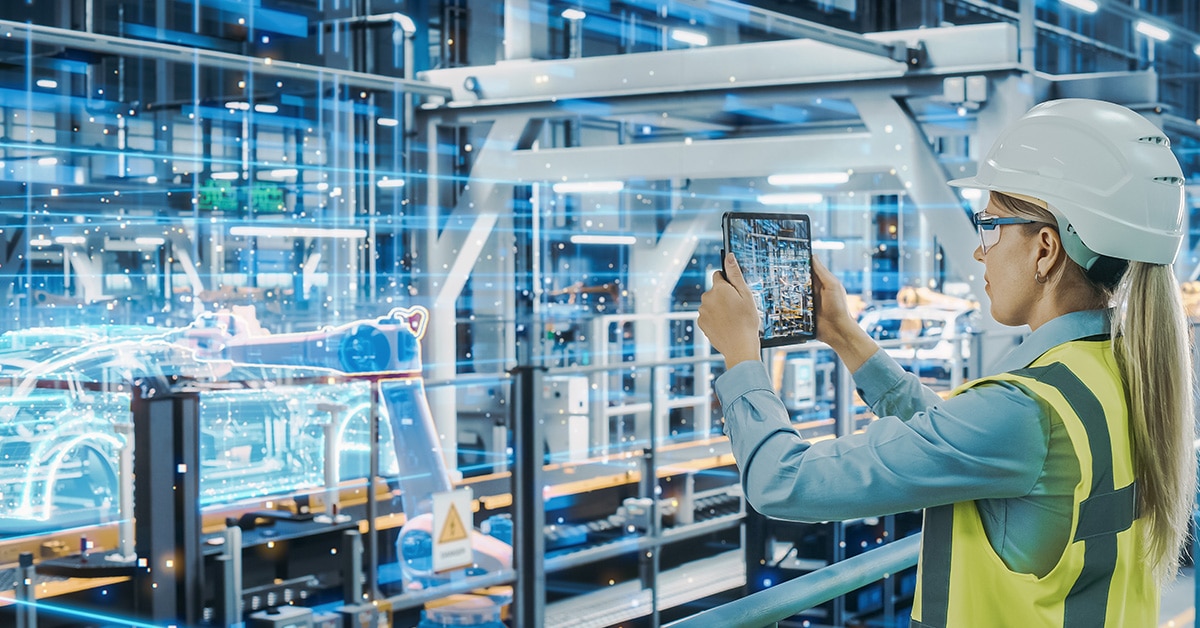




Industry 4.0, also called the Fourth Industrial Revolution or 4IR, represents the latest evolution in manufacturing, driven by data and connectivity. It focuses on the use of data to drive automation, power intelligent systems and create interconnected operations across production lines and shop floors.
This sets it apart from its predecessors. The First Industrial Revolution introduced machine-based production, while the Second laid the groundwork for mass production. More recently, the Third Industrial Revolution integrated computers, programmable logic controllers (PLCs) and robotics to help improve production speed and drive enhanced automation.
Because both revolutions rely on automation, many technologies and software tools overlap between 3IR and 4IR. With both revolutions rooted in automation, many companies see 4IR as an optional add-on to its 3IR predecessor, rather than a fundamental shift.
In this article, we’ll explain the fundamentals of Industry 3.0 and 4.0, highlight their key differences and share practical tips to help you transition successfully.
What is Industry 3.0?
Industry 3.0 was born out of the digital revolution in the 1970s with the development of technologies such as semiconductors and integrated circuit boards. The primary goals of Industry 3.0 were to reduce dependency on manual labor and increase manufacturing production accuracy.
Key advancements of Industry 3.0 included:
- PLA automation and SCADA systems
- CNC machines
- Industrial robotics
- Computer-aided manufacturing, such as CAD and CAM
While Industry 3.0 offered significant improvements in efficiency and visibility, it also came with limitations.
For example, many digital systems were isolated from others in the same network, creating what are known as data silos. In the best-case scenario, data was duplicated across these silos, leading to redundant time and effort. In the worst-case scenario, missing data in one silo meant poor decision-making in another.
In addition, many machines were effectively transformed into automated islands, which led to the need for complex, manual coordination by maintenance, quality and planning teams.
What is Industry 4.0?
Industry 4.0 focused on the creation of smart factories capable of deploying AI in manufacturing across local production lines and global networks.
While 4IR includes the use of 3IR technologies, it expanded their impact with solutions such as:
- IIoT-connected machinery
- Cloud and edge computing
- Predictive analytics
- AI and machine learning (ML)
- Horizontal and vertical integration of cyber-physical systems
The goal of Industry 4.0 is to drive more transparent production, which enables faster response to downtime risk. Using connected technologies also offers a roadmap for data-driven performance optimization and improved overall equipment effectiveness (OEE).
And the shift isn’t just hope and hype. According to Deloitte, 85% of manufacturers believe that smart manufacturing will transform how products are made and improve their competitive advantage. As noted in the Rockwell Automation 10th Annual State of Smart Manufacturing Survey, meanwhile, 95% of manufacturers have invested or plan to invest in artificial intelligence (AI) solutions in the next five years.
Industry 3.0 vs. Industry 4.0: A side-by-side comparison
The shift from 3IR to 4IR comes with changes to factory design, data handling, maintenance operations and more:
Category | Industry 3.0 | Industry 4.0 |
Factory design | Automated islands | Fully integrated network |
Data | Stored locally, limited use | Real-time and contextual |
Maintenance | Reactive/Preventive | Predictive/Prescriptive |
Workforce | Operators and technicians | Multi-skilled digital roles |
Supply chain | Local optimization | Global visibility and resilience |
Decision-making | Human-driven | AI-assisted |
Impact on maintenance and reliability
Two key benefits of 4IR transition are improved machine uptime and enhanced asset health.
Consider the automated islands of Industry 3.0—self-contained systems that operated independently without data integration. This isolation limited visibility into asset failure causes, forcing companies to depend on static maintenance schedules or react to unexpected breakdowns.
Industry 4.0, meanwhile, uses connected sensors to collect machine health data such as current vibration, temperature or pressure, and compare this information to historical averages. If data falls outside acceptable ranges, systems trigger automated alerts that activate CMMS workflows. While scheduled maintenance remains an integral part of Industry 4.0 technology, the application of intelligent tools supports failure prediction that enables work prioritization.
Here’s a quick comparison.
Machine A runs 24/7/365, producing critical components. Even short-term failures are costly for the company. Under a 3IR framework, maintenance teams create a static schedule for regular service and yearly maintenance. Technicians note common concerns, such as low fluid levels and slightly elevated temperature levels during repairs, but since these values are within tolerance, no further action is taken.
On what should be a typical Tuesday, however, the machine abruptly fails. Analysis reveals that fluid and temperature issues were symptoms of a more complex root cause. The machine is replaced, but it costs the company two weeks’ worth of production.
Using a 4IR approach, the same scenario plays out differently. Equipped with Industry 4.0 smart sensors and AI-based analytics, the company discovers the root cause early and plans a day-long stretch of downtime to fully resolve the issue. Parts are ordered in advance and additional inventory is stocked to account for the disruption. Instead of firefighting, 4IR enables predictive maintenance solutions.
The result? Greater reliability leads to fewer disruptions, which in turn lowers the total lifecycle cost of machinery and equipment.
Workforce transformation
The integration of Industry 4.0 technologies is also driving digital transformation in manufacturing as new skills are required to manage multiple data sources and ensure operational visibility.
Skills in demand include:
- Data analytics for maintenance
- PLC and network troubleshooting
- Robot and automation programming
In practice, this transformation requires two components. First are operator reskilling and upskilling programs that equip staff with the knowledge and know-how necessary to lay the groundwork for data-driven manufacturing. Second is the use of collaborative robots (cobots) capable of working with minimal human intervention while also taking on repetitive or labor-intensive tasks without sacrificing data accuracy.
The result of effective workforce transformation is the empowerment of operators or technicians as end-to-end equipment caretakers under a total productive maintenance (TPM) model.
Challenges in transitioning to Industry 4.0
Despite the benefits offered by Industry 4.0, many plans are stuck between 3.0 evolution and 4.0 maturity. Common causes of this transition trouble include:
- Legacy equipment is lacking connectivity
- Integration complexity between OT and IT networks
- Data quality issues are preventing advanced analytics
- Budget and cultural change barriers
- Leadership hesitation caused by unclear ROI
It’s also worth noting that companies often have multiple processes in different stages of industrial optimization. Some are on the edge of 4IR operations, using Industrial Internet of Things (IIoT) sensors to collect and compile data. Some are firmly in the middle of 3IR, leveraging automation for continuous improvement of production process accuracy but lacking real-time visibility, and others remain behind the curve, relying on manual assessments that are labor-intensive and error prone.
How to begin the transformation
Moving from 3IR to 4IR doesn’t happen overnight. Instead, adopting a phased strategy will steadily enhance capacity and accuracy over time.
Step 1: Start with connected OEE processes and downtime monitoring.
Step 2: Expand to real-time condition monitoring and predictive analytics.
Step 3: Standardize asset management with CMMS integration.
Step 4: Use small-scale, high-ROI pilot programs to showcase value.
Step 5: Build cross-functional alignment between maintenance, engineering, operations and IT teams.
Implementing 4IR? Think evolution, not revolution
Industry 3.0 brought automation; Industry 4.0 adds intelligence and connectivity, which unlocks uptime gains and drives workforce empowerment.
Accelerating too quickly can reduce the long-term benefits of Industry 4.0. By taking a step-by-step approach to transformation, manufacturers can reduce risk and deliver improved ROI that drives increased performance and predictive operations.
4IR is essential for maximizing uptime and staying competitive in today’s market. Ready to cut downtime and boost ROI? Explore industrial technology solutions from ATS and connect with an expert today.
References
Rockwell Automation. (2025). State of smart manufacturing report. Retrieved from
https://www.rockwellautomation.com/en-us/capabilities/digital-transformation/state-of-smart-manufacturing.html
Deloitte. (2025). 2025 smart manufacturing survey: Navigating challenges to implementation. Retrieved from
https://www.deloitte.com/us/en/insights/industry/manufacturing-industrial-products/2025-smart-manufacturing-survey.html