
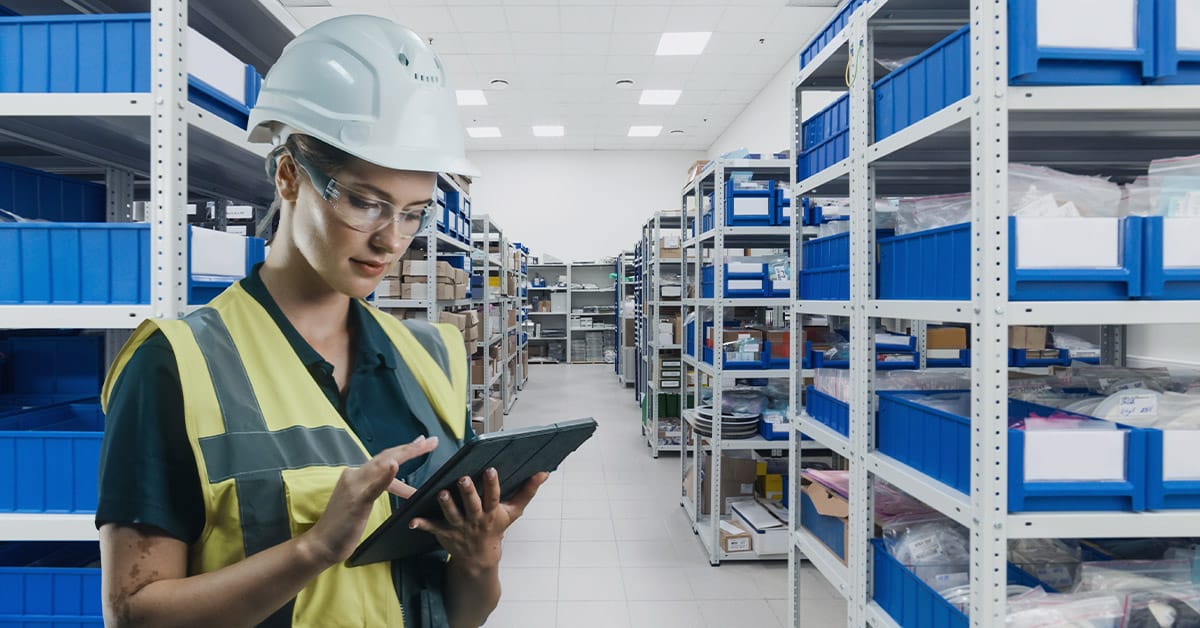




A big part of effective machine maintenance is having the right spare parts available when needed. If a vital component isn’t on the shelf when there’s a breakdown to fix or planned maintenance work to perform, production is going to suffer. Some organizations still use manual systems to manage their maintenance spares, but digital inventory management is a far superior approach.
But what is digital inventory management, and what makes it so important for manufacturers? Digitizing inventory management delivers some significant benefits compared to manual systems, but they require the right approach to implement them as successfully as possible. Being able to identify opportunities for improvement and knowing the right strategies ensures manufacturers can achieve effective inventory management.
What is digital inventory management?
Inventory management in maintenance is about knowing what parts are available for maintenance work. It links to Purchasing for parts procurement, and to Finance for budgetary control and inventory valuation. The challenge is different to that of managing raw materials inventory because:
- The variety of items to be stocked is much larger.
- Usage rates are highly variable, and to an extent, unpredictable.
- Turnover can be very low.
- Some spares are held specifically to support a single piece of machinery.
Digital inventory management refers to using a computer to track the quantities and locations of items held on the maintenance shelves. (Cost or value, and age or purchase date are other parameters usually included). There are many cloud-based platforms available that decentralize the database, so users across multiple locations can stay up-to-date at all times through connected mobile apps or desktop environments. Regardless of the form factor, real-time dashboards make it possible for users to see a bird’s eye view of the entire organization or drill down into the specifics of a particular item with ease.
The alternative is to use a card-based system, or to rely on the memory of the maintenance stores supervisor, neither of which are ever satisfactory when machine availability is high priority.
A system for digital inventory management comprises software for logging transactions and keeping records, plus operating procedures that specify how inventory will be managed. The inventory management software can be a standalone package, although is often integrated into the computerized maintenance management systems (CMMS) many manufacturers use.
Disadvantages of manual parts inventory management
There are a number of problems with the manual systems still used by some manufacturers.
- Updates are slow, so parts may not be on the shelves when needed, even if the system says they are.
- Records are prone to errors, so quantities and locations may be inaccurate.
- Access to the records is limited to a few individuals with other business functions unable to retrieve or review information as needed.
- Parts are missing, so mean time to repair (MTTR) increases.
- Components are difficult to locate or deliver, so technicians lose productive time waiting.
- Systems are outdated and disconnected, so inventory data becomes siloed across departments.
Collectively, these mean parts may not be available when needed, extending downtime and requiring rush orders with premium shipping charges. At the same time though, inventory will almost certainly be higher than it could be, although some of the parts stocked will be obsolete.
In addition, manual inventory management creates challenges for the Finance and Purchasing functions. An accurate valuation of the spare parts inventory will be almost impossible to obtain, and opportunities to reduce supplier numbers and consolidate orders will be missed.
Benefits of digital inventory management systems
Computerizing the management of spare parts inventory offers a lot of advantages over traditional inventory management systems. It’s also worth noting that capabilities have advanced considerably in recent years, so a new system will offer more extensive capabilities than one that has been in place a decade or more.
Specific benefits include:
- Inventory visibility: Maintenance personnel and other business functions can see stock levels on hand, storage locations and valuations at a glance.
- Real-time updates: Quantities, values and locations will never lag behind the physical transactions.
- Accurate data: Scanning barcodes and RFID tags can eliminate data entry errors.
- Saves time: Stores personnel are no longer spending hours updating inventory records.
- Equipment linkages: Using the CMMS, specific spare parts can be tied to individual machines, avoiding the problem of holding spares for equipment no longer used.
- Predictive maintenance readiness: Digital inventory management provides the data foundation maintenance teams need to support predictive maintenance by streamlining procurement and improving parts availability.
- Procurement based on PM schedules: When work is scheduled on the CMMS, an integrated inventory management module checks parts availability and can initiate reordering if needed.
- Lower inventory levels: Maintenance can work with Purchasing on consignment stocking and minimum service levels, which reduce the value of inventory on-hand.
- Saves space: Lower inventory means less storage space is needed.
- Criticality-based stocking: Digital inventory management systems give maintenance teams the insight needed to prioritize parts that have the greatest impact on uptime.
- Data analytics: A digital inventory management system enables analysis of usage trends that can inform data-based decision-making.
An additional benefit deserving separate recognition is the impact on machine availability. Accurate data and digital inventory tracking mean the right spares are always available when needed for planned maintenance or breakdown repairs. This translates to higher availability and improved OEE while supporting reliability-centered maintenance efforts.
How to implement a digital inventory management system
Having recognized the value of a modern, computerized inventory system, here’s how to go about putting one in place:
1. Conduct an audit of the current spare parts inventory. This should include physically verifying the quantities on-hand and the locations.
2. Discard or sell obsolete inventory. Shelf space should not be taken up by parts that will never be used. (Some businesses find a 5S or “Red Tag” exercise effective for removing this kind of inventory.)
3. Specify requirements. This is a project that should be handled like any other large software purchase.
4. Select a solution. The easiest solution might be to add an inventory management module to the existing CMMS or other industrial asset management software. Include barcode scanning and possible RFID tag reading to maximize data accuracy.
5. Review parts inventory policies and update as necessary. (A new solution will probably allow a higher degree of control, in turn meriting different purchasing and inventory holding policies.)
6. Implement the new software and hardware and import inventory data.
7. Train users in how to operate and get the best from the system.
8. Monitor operation, identifying and implementing improvements as needed.
9. Assign governance roles and tasks.
10. Create a continuous improvement plan.
The key to making this work is ensuring the organization has clean master data. Engaging in a pilot rollout program before full deployment also helps reduce risk and support a smoother implementation.
Digital inventory management and predictive maintenance
Predictive maintenance depends on having spare parts available when needed. A digital inventory system supports this by enabling sensor-driven consumption forecasting, helping ensure the right parts are in stock before maintenance tasks are triggered. When sensor data indicates a component is nearing failure, the system can automatically generate a work order and verify part availability—reducing delays and supporting proactive maintenance.
Support for raising machine availability and performance
Machine maintenance needs an inventory of spare parts if downtime is to be minimized. That inventory must be managed, however, to prevent it from growing too large and occupying too much space and to ensure the right parts are available when required.
Digital inventory management helps manufacturers meet those goals. When integrated into a CMMS, it also supports higher levels of maintenance, including planned and predictive maintenance strategies. ATS helps manufacturers achieve higher levels of reliability and uptime by optimizing equipment maintenance. Spares inventory and MRO management are also part of the portfolio of services we offer. Contact us to learn more.