
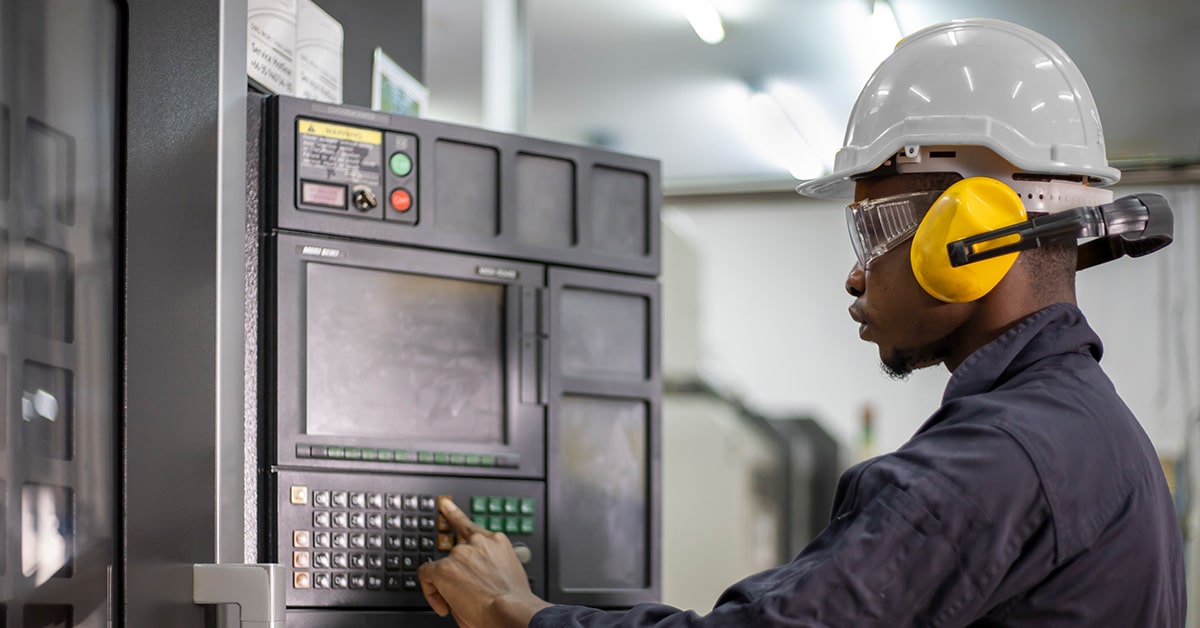




A computer numerical control (CNC) lathe machine is an automated milling machine tool that rotates a workpiece on a spindle. A cutting tool moves along the workpiece at various axes to remove material. CNC lathes are critical machines for producing high-precision cylindrical components across the aerospace, automotive and woodworking industries. They are also used in metal fabrication and even glass-working.
However, even minor maintenance issues in a CNC lathe machine can lead to dimensional inaccuracies, tool wear and unexpected downtime. A well-structured CNC lathe maintenance program supports consistent performance, tight tolerances and maximum uptime.
Advanced Technology Services (ATS) recommends combining daily inspections, preventive and predictive maintenance, and data-driven monitoring of CNC lathes to protect equipment, productivity and product quality at industrial facilities. What your particular maintenance schedule will look like will depend on your facility’s workflow. This guide covers our recommended essential CNC lathe best practices, maintenance tips, common failure points, and how to improve long-term equipment reliability. Read on to discover more.
How CNC lathes work in industrial applications
The key components of a CNC lathe include the headstock with the spindle and motor, the chuck, tool turret, tailstock, carriage, and CNC controller. These components work together to turn materials, with the spindle rotating the workpiece held by the chuck. Tools on the turret move along the workpiece to remove material.
Key components of a lathe
- Headstock and spindle motor: Holds and rotates the workpiece at high speeds.
- Chuck: Clamps the material, typically using three-jaw or four-jaw designs for holding stock.
- Bed: Supports all components and ensures stability.
- Tool turret: Rotates and holds multiple cutting tools, allowing for automatic tool switching.
- Tailstock: Supports the far end of the workpiece to prevent vibration and deflection during heavy cutting or drilling operations.
- CNC controller: Translates instructions into commands through the computer interface.
- Carriage: Carries the tool turret, moving along the workpiece for turning or facing.
Why CNC lathe maintenance is critical
Neglecting CNC lathe maintenance can lead to reduced precision, decreased productivity and costly repairs. Tool breakage, spindle failure, increased scrap rates, and surface finish defects are some of the most common issues that arise from neglected CNC machine maintenance. When regular maintenance is not performed, components may stick and overheat due to lack of proper machine lubrication and calibration. This causes alignment and accuracy to suffer. Vibration and debris also will affect performance, reducing the lifespan of the machine. Proper maintenance helps reduce downtime and safety hazards.
Are you seeing tolerance issues or experiencing unexpected machine downtime on your lathe? Talk to an ATS expert about your equipment reliability. We can help with your preventive maintenance programs.
Common CNC lathe maintenance issues
Common CNC lathe maintenance issues include tool wear, lubrication failure, overheating, and buildup of debris, resulting in dimensional inaccuracies and unexpected machine downtime. Preventive maintenance, such as regular cleaning, inspecting way covers, lubrication, and ensuring correct alignment, is essential.
Common CNC lathe issues
- Spindle bearing wear: Constant friction will lead to bearing wear without proper lubrication. This will create more vibration and noise resulting in poor surface finishes and failed parts.
- Chuck misalignment: Taper cutting, poor concentricity and vibration are the results of chuck misalignment. This can lead to workpiece errors that do not meet required tolerances.
- Tool turret errors: The result of a dirty turret and mechanical wear from a lack of lubrication, damaged coupling pins, and sensor failures. This can cause overshoot, misalignment and failure to lock errors.
- Ball screw wear and backlash: Improper lubrication and debris buildup leads to ball screw wear and backlash. This can result in poor surface finishes and workpiece faults.
- Guideway contamination: This is caused by metal chips, dust, residue, and debris. Equipment will suffer rapid wear and increased friction.
- Coolant system failures: Commonly caused by pump malfunctions, clogged lines and improper concentration. This will result in decreased equipment life, poor surface finishes and overheating.
- Lubrication breakdown: Insufficient lubrication or contamination can lead to worn spindles and guideways, jammed axes, and ball screw failure. This leads to reduced machine lifetime.
- Electrical and control faults: Loose wires, blown fuses and failing sensors are often caused by excessive vibration and heat. This will cause equipment to fail.
Daily CNC lathe maintenance checklist
Daily maintenance of a CNC machine tool should focus on lubrication levels, fluid levels, and cleaning debris from way covers to ensure accuracy and prevent damage. This daily maintenance is crucial in keeping lathe machines up and running.
Daily CNC lathe maintenance checklist
- Clean chips and debris from machine
- Inspect cutting tools and inserts
- Check coolant levels and flow
- Verify lubrication systems
- Inspect chuck and work holding
- Monitor spindle noise and vibration
- Check for leaks or abnormal conditions
- Ensure safety systems are functioning
Preventive maintenance for CNC lathes
Preventive maintenance is important in catching problems before they can cause equipment failure in lathes. This helps reduce costly repairs, supports accuracy, reduces machine downtime, and extends machine life.
Preventive maintenance tasks
- Lubrication of guideways and ball screws
- Spindle inspection and servicing
- Alignment and calibration checks
- Coolant system maintenance
- Electrical system inspections
- Filter replacements
- Control system diagnostics
CNC lathe spindle and chuck maintenance
Spindle and work-holding systems are critical components in CNC machining lathes as they ensure safety, precision, and stability by securely gripping the workpiece and rotating it at consistent speeds. These systems prevent the workpiece from slipping or being ejected, allow for high-speed material removal, ensure accurate, repeatable tolerances, and prevent vibrations that degrade surface finish.
Spindle precision must be maintained constantly; otherwise, workpieces will not meet required specifications. The spindle should be monitored for vibration, temperature, and noise levels, which can indicate issues. The chuck and lathe jaw must be monitored as well to ensure turning accuracy and proper gripping of the workpiece. Regular cleaning and lubrication will go a long way in preventing chuck wear, runout, vibration, and loss of accuracy.
Coolant system maintenance for CNC lathes
CNC lathes require coolant system maintenance to prevent overheating. This involves monitoring concentration levels daily, checking pH levels, and cleaning tanks, and replacing filters every 3-6 months to prevent bacterial growth and tool wear. Performing these coolant management maintenance tasks will help reduce friction, dissipate heat and improve chip removal efficiency. Proper maintenance can help protect against machine corrosion, reduce the risk of thermal distortion in parts and support longer operational life.
CNC lathe calibration and precision control
Operators can maintain tight tolerances on CNC lathes by controlling the thermal environment, performing regular CNC maintenance, such as software updates and machine calibration, and using high-precision tooling. Many facilities use thermal compensation systems, employ sharp carbide tools to minimize deflection and utilize in-process probing for real-time measurements. Proper maintenance should also include axis alignment checks, regular accuracy testing and tool offset management.
Using condition monitoring for CNC lathes
Early failure detection in CNC lathe machines can improve reliability by transitioning maintenance from a reactive run-to-failure model to a proactive, data-driven strategy. This is commonly known as predictive maintenance and machine health monitoring. By continuously monitoring critical variables such as vibration, temperature, spindle load, and acoustic emissions, early detection systems can identify anomalies indicating wear or misalignment before a failure occurs.
Want real-time visibility into your CNC lathe performance? See what’s recommended for your facility. ATS offers predictive maintenance solutions, such as vibration analysis and temperature monitoring. We also offer Reliability 360® Machine Health Monitoring. Contact us today to learn more.
Use cases: Where CNC lathe maintenance is most critical
Many industries rely on CNC lathe performance. Aerospace, automotive, defense, oil & gas, medical devices, woodworking, and precision CNC machining and fabrication shops demand consistent, reliable performance from CNC lathes. These industries have high-precision and tolerance-sensitive projects. The slightest error can cause massive defects.
This makes regular maintenance, such as daily machine inspections and lubrication of the spindle and guides, essential. Regular calibration and coolant management help prevent overheating from high-volume production environments that run 24 hours a day, seven days a week. These continuous running operations require preventive and predictive maintenance due to the heavy demands placed on the machines.
Integrating CNC lathe maintenance into a CMMS
Integrating CNC lathe maintenance into a computerized maintenance management system (CMMS) can help boost machine uptime by transforming reactive repairs into predictive maintenance driven tasks. A CMMS can help with complex maintenance scheduling, historical maintenance tracking, work order issuance and tracking, predictive machine monitoring, and spare parts inventory management. A CMMS helps simplify the standardization of CNC lathe maintenance by automating maintenance tasks and providing insight into machine health through continuous monitoring sensors.
How ATS supports CNC lathe maintenance and reliability
ATS helps support organizations through our specialized, data driven preventative and predictive maintenance solutions. We offer technology-driven equipment monitoring solutions, reliability-centered maintenance programs and skilled technician support. We can help manufacturers reduce downtime, extend asset lifespans and improve throughput. Get in touch to see what fits your facility.
Protecting precision in CNC lathe operations
CNC lathes are highly sensitive to maintenance issues as they are precision instruments requiring extreme accuracy for structural rigidity, bearing health and surface alignment. Debris accumulation, lack of lubrication, temperature fluctuations, and vibration can cause misalignment and impair precision. This leads to poor surface finishes, reduced tool life and costly downtime.
Having preventive and predictive maintenance strategies in place will help improve early issue detection, reduce downtime, and protect productivity and quality. Finding what options work best for your manufacturing facilities requires a dedicated partner. This is where ATS can help. We provide manufacturers integrated facility maintenance strategies that combine technology-driven solutions, skilled technicians and proven maintenance processes. Contact us today to learn more.
