


Bearings keep manufacturing equipment running smoothly by supporting loads and reducing friction between moving parts. Because those parts are in constant contact, bearings are also prone to premature wear and tear.
Consider survey data, which found that just 4% of bearings met their total expected service life. Only 23% of bearings exceed 90% of their expected lifespan, and 60% fail somewhere between 70% and 90%.
Common manufacturing machines that rely on bearings include:
- Motors
- Pumps
- Compressors
- Fans and blowers
- Conveyors
- Gearboxes
- CNC spindles
- Packaging equipment
- Industrial presses
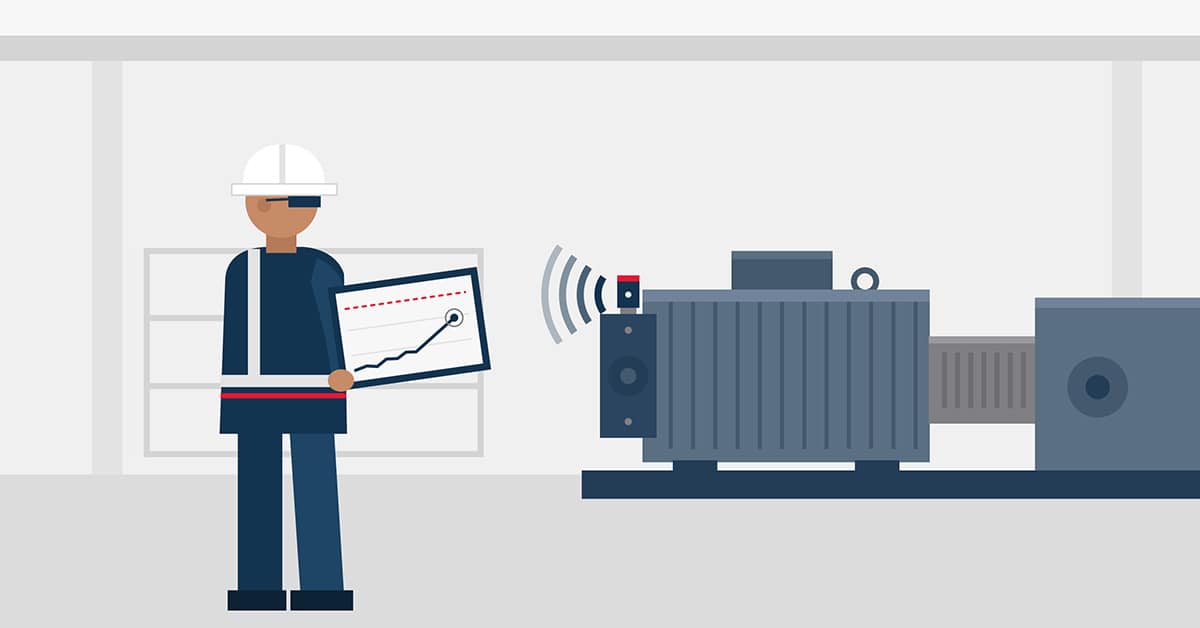
Bearing wear often starts gradually, then speeds up as damage spreads. Bearing condition monitoring enables early detection using vibration, temperature, lubrication, acoustic, and other data to identify wear and take action before it causes equipment failure.
The importance of bearing condition monitoring
Bearings support the moving parts of a machine, so those parts can carry the load of an operation or process. For example, ball bearings transfer loads from rotating shafts or axles into support structures, which extends the useful life of those shafts.
If bearings fail, the results can range from inconvenient to catastrophic. In the example above, a failed bearing might increase the heat and pressure on a rotating shaft, reducing its efficacy and shortening its lifespan. Bearing failure could also lead to sudden shaft seizure, which poses significant safety risks for workers and forces unexpected downtime.
Potential failure issues and impacts include:
Bearing issue | Potential impact |
Wear or fatigue | Increased vibration and eventual failure |
Lubrication breakdown | Friction, heat and accelerated damage |
Contamination | Surface damage and shorter bearing life |
Misalignment | Uneven loading and premature wear |
Imbalance | Higher vibration and stress on components |
Common signs of bearing wear or failure
In many cases, bearing failure is preceded by warning signs. Staff may hear noises such as screeching or grinding, feel increased vibrations in machinery, or find themselves responding to frequent equipment alarms.
By monitoring bearings for the early signs of failure, manufacturers can identify possible causes and take corrective action.
Warning sign | Possible cause | Recommended action |
Increased vibration | Wear, imbalance, looseness, or misalignment | Inspect bearing, shaft alignment and mounting |
Rising temperature | Lubrication issue, friction or overload | Check lubricant, load and cooling conditions |
Unusual noise | Surface damage, contamination or lubrication failure | Inspect bearing condition and lubrication |
Metal particles in oil/grease | Bearing surface wear | Perform lubricant analysis and inspect the component |
Increased current draw | Mechanical resistance or bearing drag | Review motor current and inspect rotating assembly |
Frequent alarms | Developing fault or threshold issue | Review trends and schedule corrective action |
The sooner these issues are addressed, the better. While a small amount of increased vibration may not impact equipment performance, vibration intensity can quickly scale once bearings start to fail.
If warning signs are heard or observed, manufacturers are best served by conducting an inspection of affected parts to pinpoint the root cause. In case of rising temperature, for example, inspection may reveal low lubricant levels tied to damaged seals. Solving this problem before bearings fail helps minimize operational downtime.
Common causes of bearing failure
Why do bearings fail? While there’s no single answer, there are several common causes of bearing failure often seen in manufacturing environments. They include:
- Improper lubrication
- Contamination
- Misalignment
- Imbalance
- Overloading
- Incorrect installation
- Poor fit or mounting issues
- Corrosion
- Excessive heat
- Electrical damage
- Inadequate sealing
- Normal fatigue over time
Different causes require different monitoring approaches. Not sure which approach works best? Start with these three steps.
Step 1: Determine criticality
Not all bearing failures are equally critical. Evaluate production processes and rank equipment by operational priority to create a bearing maintenance framework.
Step 2: Identify the most likely failure mode
Next, identify the likely failure modes for critical devices. If excessive heat is the most pressing problem, consider connected sensors capable of collecting real-time temperature data. If misalignment is common, have operators regularly inspect machinery and verify bearing conditions.
Step 3: Pinpoint preventable causes
Finally, teams need to separate preventable causes from those that cannot be resolved. For example, material corrosion or lubricant contamination can be corrected and prevented, but normal fatigue over time cannot. Preventable causes call for corrective action, while inevitable causes should be monitored over time.
These steps provide a path to effective monitoring. For example, bearings in critical equipment that show early warning signs of excessive current draw may indicate excessive load tied to deteriorating bearing conditions. Scheduled downtime for inspection and repair can resolve the issue before the machinery fails.
In the case of non-critical bearings experiencing normal wear and tear, meanwhile, full equipment stoppage may not be necessary. Instead, companies can calculate the remaining useful life (RUL) of these bearings and schedule bearing replacement based on this estimate.
Bearing condition monitoring methods
There are five broad types of bearing monitoring methods: Vibration analysis, temperature monitoring, lubrication and oil analysis, ultrasonic and acoustic monitoring, and motor current analysis.
Here’s a look at each in more detail.
Vibration analysis
Changes in vibration signatures are often among the first signs that bearings are beginning to wear. As a result, vibration analysis is one of the most common methods for detecting bearing defects.
This monitoring method plays an important role in predictive maintenance; analysis of trending vibration data can help identify issues before failure occurs.
Temperature monitoring
Rising temperatures may indicate multiple issues such as insufficient lubrication, excess friction, operational overload, lubricant contamination, or problems with cooling processes.
In some cases, vibration changes occur before temperature fluctuations. In others, this order is reversed. To reduce the risk of defective signals going overlooked, it’s worth using temperature and vibration monitoring in tandem.
Lubrication and oil analysis
These types of analysis can detect problems, including contamination, moisture, lubricant degradation, and improper lubricant condition. Because bearing life is closely tied to lubrication and oil quality, regular analysis is essential for reliable operations.
Ultrasonic monitoring
High-frequency sound patterns may indicate early signs of wear but are typically beyond the range of human hearing. Ultrasonic monitoring can detect these patterns, giving teams a head start on tracking bearing problems. Ultrasound-based monitoring is also useful in monitoring hard-to-reach assets and is often paired with vibration analysis.
Motor current analysis
Motor current analysis can reveal increased mechanical resistance or load changes, which may indicate that bearing faults are causing motors to work harder. Current analysis is often used as part of broader machine health monitoring for motors, conveyors, fans, pumps, and automated systems.
Critical rotating equipment benefits from multiple monitoring methods to help pinpoint bearing failures that develop through different pathways. Speak to the experts at ATS about building a sensor and maintenance approach that complements your manufacturing operations.
Real-world example: Detecting bearing wear before failure
Consider an illustrative example: a manufacturer relies on a large-scale conveyor system to move parts and finished products where they need to be as quickly as possible.
Over the last few months, however, condition monitoring has shown increased vibration levels and steadily rising temperatures during normal operations. Given that the conveyor system relies heavily on roller bearings for smooth operation, the manufacturer begins an investigation to identify the problem and resolve the issue.
Potential causes
This starts with an evaluation of potential causes. Possible issues include:
- Bearing wear
- Poor lubrication
- Misalignment
- Excessive load
- Contamination
- Imbalance
The root cause may be singular, or it may be tied to multiple factors. For example, misalignment can increase friction and heat, which breaks down lubrication faster. Replacing the lubricant isn’t enough; if maintenance staff don’t correct the misalignment, the lubrication problem will return.
Monitoring response
With possible causes identified, manufacturers need a condition monitor and response plan.
This begins with a baseline comparison. How do temperature and vibration sensor readings compare to baseline values? How do they align with short- and long-term trends? On-site inspection of lubrication condition, bearing alignment, belt tension, and motor current draw provides context to this data, allowing maintenance staff to determine the best path forward.
In the case of the company’s conveyor belt, a bearing replacement is required. To help minimize disruption, teams should confirm that spare parts are available on-site and schedule replacement during planned downtime.
Likely outcomes
Identifying, monitoring and resolving bearing issues offers multiple benefits for the manufacturer.
First is improved conveyor uptime, which can turn reduce the need for emergency repairs and support steady production flow. Targeted preventive maintenance scheduling can also help prevent secondary motor or gearbox damage, saving money on spare parts and extending the RUL of conveyor belt equipment.
Optimize bearing reliability
Bearings allow machines to operate at peak performance but are subject to failure if they are not properly aligned, balanced, lubricated, and cleaned.
Reliable bearing operation depends on condition-based monitoring that identifies possible issues in real-time and gives teams the data they need to act. There’s no single best monitoring approach for bearings. The right choice depends on asset criticality, likely failure mode, speed, load, environmental conditions, and available data.
ATS helps manufacturers turn bearing health data into maintenance action through interpretation, prioritization, corrective recommendations, and execution. ATS experts will evaluate your rotating equipment through the lens of bearing criticality, failure history, operating conditions, and downtime risk.
With the right monitoring methods applied to the right assets, manufacturers can detect bearing wear earlier, schedule repairs more effectively and reduce unplanned downtime. Ready to improve bearing reliability and reduce rotating equipment downtime? Talk to ATS about predictive maintenance support.
References
Alarcon, J. (n.d.) Why bearings fail to reach expected lifespans. Precision Lubrication. https://precisionlubrication.com/articles/bearing-lifespans/
