



Automotive manufacturing faces pivotal changes driven by electrification and digitalization. While combustion-engine vehicles remain a staple of the auto industry, original equipment manufacturers (OEMs) and suppliers must increasingly balance established production with rising hybrid adoption and evolving electric motor vehicle strategies across global markets.
Paired with evolving sustainability mandates, increasing process digitalization and expanding global markets, automakers need a leaner, smarter and more resilient approach to operations. The result is a race to meet consumer expectations without falling short of regulatory requirements, while simultaneously navigating legacy production line challenges and ensuring consistent quality.
Here’s a look at 8 of the top automotive manufacturing trends and what they mean for OEMs.
1. Digital services and human-machine interfaces (HMIs)
According to S&P Global, digital transformation isn’t just driving internal change—it’s opening the door to new automotive revenue.
Consider the rise of generative AI (GenAI). While this technology is increasingly used to help manufacturers track key trends and automate critical processes, it’s also making its way into car cockpits in the form of GenAI-powered chatbots.
For manufacturers, this demands a strategic shift. While many vehicles now include touchscreen dashboards and digital heads-up displays, additional infrastructure is required to support the speed and scale required by GenAI services.
In practice, manufacturers typically face two paths: Build the internal skills needed to design, test and deploy GenAI solutions, or partner with technology leaders to help deliver the digital foundation these systems require.
No matter which path they choose, manufacturers remain responsible for what’s under the hood—the architecture and components that keep systems stable, responsive and reliable at scale.
2. Smart factories and automation acceleration
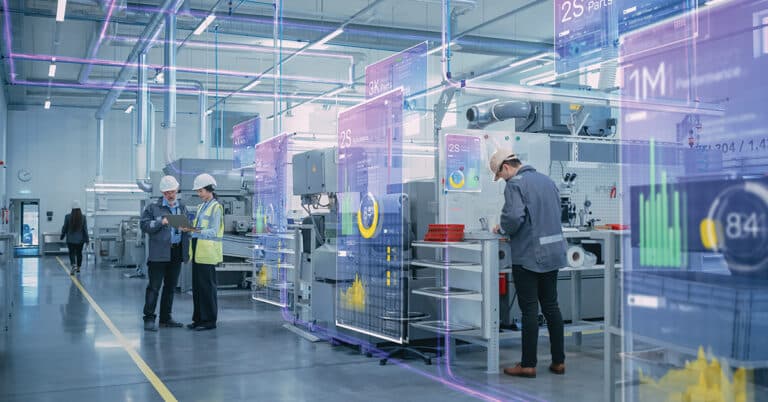
Driven by the rise of Industry 4.0, smart factories are also on the rise. The primary advantage of these factories is automation. Using a combination of connected sensors, real-time data and purpose-built equipment, OEMs are now able to streamline complex processes such as parts assembly, quality control and machine maintenance.
Deploying Industry 4.0 offers multiple benefits for automotive companies, such as:
- Collaborative robots: Also called “cobots,” these devices work alongside human staff to manufacture precision parts.
- AI-powered quality inspections: AI in automotive manufacturing now powers intelligent inspections that can help spot quality problems ASAP.
- IIoT-enabled facilities: Connected Industrial Internet of Things (IIoT) frameworks provide real-time data for strategic decision-making.
- Digital maintenance dashboards: Digital dashboards offer clear visualizations of current operations, upcoming maintenance tasks and equipment issue warnings.
- Support for multi-path production: Automation enables the management of multiple production line paths, which enables OEMs to meet the growing demand for hybrid electric vehicles.
3. Lightweight materials and advanced manufacturing techniques
Lightweight materials and emerging discrete manufacturing techniques are helping reduce the total footprint of EV, hybrid and connected vehicles. These advances offset the significant weight of batteries while maintaining the strength and resilience manufacturers expect across all vehicle types.
For example, many OEMs in the automobile industry are shifting to the use of aluminum, magnesium alloys, ultra-high-strength steel (UHSS) and carbon fiber composites as a way to improve efficiency, ensure fuel economy and achieve EV range goals. As noted by Energy.gov, the maximum average range of EVs was 405 miles in 2021; today, it’s 516 miles. New materials make this possible but require new manufacturing techniques.
Some of these techniques include advanced processes such as hot stamping, hydroforming and the use of additive manufacturing, also known as 3D printing. By taking a layer-by-layer rather than a subtractive approach to parts manufacture, OEMs are better able to predict material needs and reduce material waste.
Effectively implementing these techniques, however, requires precision maintenance, real-time temperature and humidity controls, and specialized equipment calibration. In addition, maintenance teams will require additional training to manage more complex tooling needs and robotic repairs.
4. Predictive maintenance and reliability as strategic priorities
High-speed, high-volume production lines demand predictive maintenance to prevent costly downtime. Even minutes can cost tens of thousands in lost output, and teams can spend significant time and effort bringing systems back online.
It’s also worth noting that not all equipment failures are created equal. For example, if late-stage quality assurance tools experience downtime, companies can create a strategy to navigate completed parts evaluation when tools are back up and running. If battery assembly stations experience sudden failure, however, it can throw entire production lines into disarray.
As a result, there’s a growing emphasis on predictive maintenance and reliability as strategic advantages for OEMs. Unlike reactive maintenance, which occurs after a system has failed, predictive maintenance uses real-time condition monitoring through vibration and pressure sensors, thermography and AI modeling to identify failure indicators and address possible failure points before they cause downtime.
Benefits of predictive maintenance include:
- Reduced scrap and rework
- Improved overall equipment effectiveness (OEE) and cycle times
- Enhanced labor planning and maintenance scheduling
5. Supply chain reinvention and nearshoring trends
Recent geopolitical tensions combined with the uncertainty of long global logistics routes have led to the reinvention of supply chain operations through:
- Nearshoring and reshoring: Nearshoring is the process of moving manufacturing operations and supply chains closer to home. In the United States, for example, Mexico is a popular nearshoring choice. Reshoring in manufacturing, meanwhile, brings operations back to home soil, while onshoring is the process of building net-new local facilities. According to Bain & Company, 80% of COOs plan to increase onshoring or nearshoring in the next three years to help reduce dependency on long global supply chains.
- Expanding vendor networks: OEMs are also expanding vendor networks to limit the chance of material delays and to help bolster staffing needs on demand. This includes the use of local suppliers and service providers that understand the automotive industry and its requirements.
- Keeping larger safety inventories on hand: In addition, manufacturers are opting to keep larger safety inventories on hand. This provides a larger window to address supply chain issues before productivity is negatively impacted.
Automotive manufacturers are also deploying technologies such as digital procurement tools and integrated maintenance, repair and operations (MRO) supply systems to increase supply chain visibility. This practice extends to modern maintenance teams, enabling them to integrate inventory optimization and ensure critical parts availability.
6. Workforce transformation and skills shortages
As workforces transform and older staff retire, automakers face growing skills shortages. By 2030, the manufacturing industry may see 2.1 million jobs go unfilled, resulting in a $1 trillion loss per year.
Roles most affected by these shortages fall at both ends of the manufacturing spectrum. For example, older and more experienced tradespeople often carry in-depth knowledge of legacy system architecture and the interactions between programmable logic controllers (PLCs), production line equipment and hardwired sensors. With many of these staff retiring, companies face challenges in bringing younger staff up to speed.
On the other side of the line are robotics and mechatronics specialists, both of which are required to make the most of autonomous assembly operations and the use of collaborative robots, or “cobots.”
To help close this gap, OEMs are adopting new approaches such as:
- Upskilling: Upskilling offers additional training to staff, allowing them to improve and expand their skillsets. This helps mitigate the impact of retirements, employee churn and the integration requirements of new technologies.
- Apprenticeships: Apprenticeships see more experienced staff educating younger employees about the unique operations tied to legacy systems. While many OEMs are reducing their reliance on these legacy tools, they are often so integral to production processes that removing them entirely would be prohibitively expensive.
- Multicraft technician models: In a multicraft technician model, techs are trained in multiple disciplines, such as the maintenance of electric vehicle (EV), hybrid electric vehicle (HEV) and internal combustion engine (ICE) production equipment.
- Outsourced skilled workforces: Outsourced skilled workforces offer an on-demand supplement to in-house staff. Experts can be brought in to handle key maintenance tasks, identify operational inefficiencies or bolster production line processes.
7. Sustainability and energy efficiency in auto manufacturing
According to a recent study, more than 30% of consumers are willing to pay more for EVs that include sustainably made batteries. Meeting this expectation requires detailed environmental, social and governance (ESG) commitments from automakers—goals that are directly impacted by operational efficiency.
In practice, OEMs now prioritize the reduction of waste, energy consumption, water usage and carbon emissions as a way to demonstrate their active role in meeting ESG targets.
Key components of these efforts include:
- Energy-efficient equipment
- Regenerative systems
- Closed-loop cooling
- Predictive maintenance strategies
In practice, sustainability directly impacts brand reputation, regulatory compliance and overall cost savings.
8. Increasing production flexibility for mixed-model manufacturing
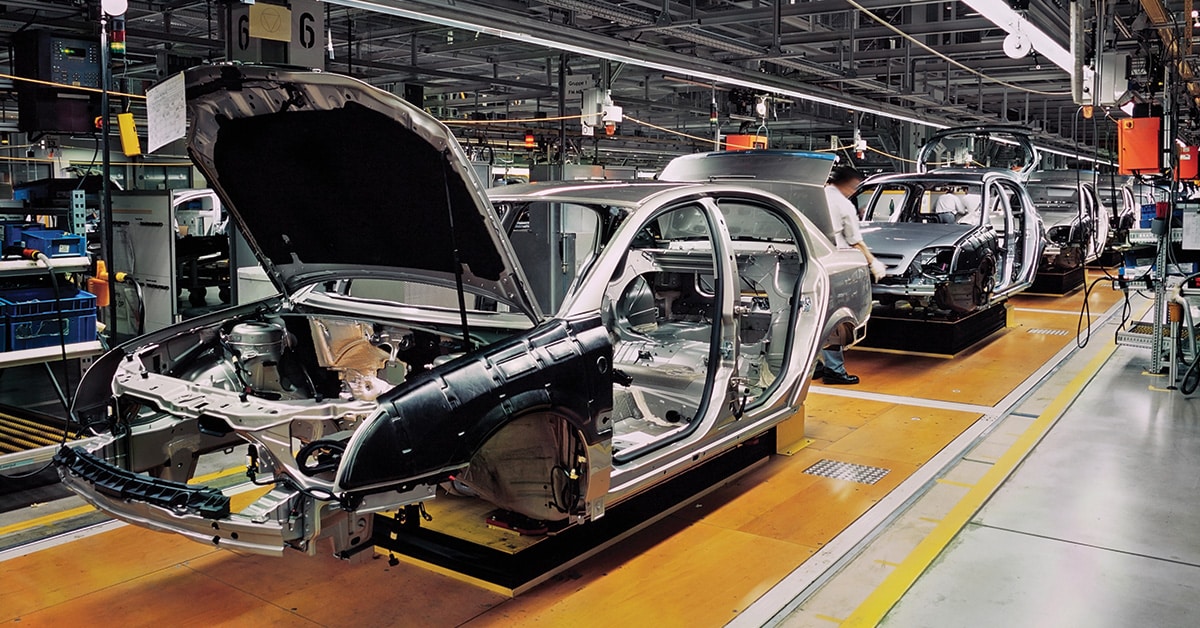
As OEMs navigate fluctuating EV demand alongside continued ICE production and rising hybrid volumes, manufacturers need to strike a balance between ICE, HEV and full-electric car production. This requires the adoption of a mixed-model approach that allows the simultaneous production of all three vehicle types without causing production shortfalls or slowdowns.
This starts with solutions such as quick-change tooling, modular work cells and adjustable automation processes that can be modified in real-time to account for changing production priorities. OEMs also benefit from predictive insights that enable the scheduling of necessary maintenance around production sequencing. Finally, it’s important to cross-train workforces for multiple equipment types and processes to ensure consistent quality across ICE, HEV and EV components.
Embracing the automotive manufacturing evolution
Manufacturing is rapidly evolving as OEMs adapt to a shifting mix of ICE, hybrid and electric vehicle production, alongside smart factory operations, sustainability initiatives and changing consumer trends. Successful manufacturers will take a future-proof approach that prioritizes flexible production, data-driven reliability and ongoing workforce transformation.
While it’s possible to tackle all of these tasks in-house, automotive manufacturers are often better served through partnerships with expert service providers. With ATS, OEMs can access:
- Full-service automotive industrial maintenance support for high-volume, high-precision environments
- Predictive maintenance solutions, reliability services and condition monitoring programs
- Skilled multicraft technicians experienced with robotics, automation, electrical systems and CNC operations
- MRO optimization to help reduce inventory costs and improve parts availability
- Scalable workforce solutions for plants navigating labor shortages or undergoing rapid expansion
Embrace automotive industry trends and empower production, maintenance and workforce operations with ATS. Let’s talk.
References
Beecham, M. (2026, January 8). Automotive market trends 2026: Navigating volatility, innovation and opportunity. S&P Global. https://www.spglobal.com/automotive-insights/en/blogs/2026/01/automotive-market-trends-2026
Dorer, J. (2025, April 1). Bridging the labor gap in US manufacturing. Manufacturing Today. https://manufacturing-today.com/news/bridging-the-labor-gap-in-us-manufacturing/
Gehlmann, F., Haustein, S. & Klöckner, C. (2024, March). Willingness to pay extra for electric cars with sustainably produced batteries. ScienceDirect. https://www.sciencedirect.com/science/article/pii/S1361920924000671
Hanbury, P., Ciuró, J., Cruz, C., & Daubin, S. (2025, March). Nearshoring: Overcoming the obstacles. Bain & Company. https://www.bain.com/insights/nearshoring-overcoming-the-obstacles/
U.S. Department of Energy. (2024, December 30). FOTW #1375: Median EV range in model year 2024 reached a record high of 283 miles per charge. https://www.energy.gov/eere/vehicles/articles/fotw-1375-december-30-2024-median-ev-range-model-year-2024-reached-record
U.S. Energy Information Administration. (2025, May 30). Hybrid vehicle sales continue to rise as electric and plug-in vehicle shares remain flat. https://www.eia.gov/todayinenergy/detail.php?id=65384