





There are several different types of maintenance strategies that may be used in a successful manufacturing operation. In general, most facilities will draw upon four types of maintenance strategies:
- Corrective maintenance (or reactive maintenance)
- Preventive maintenance
- Predictive maintenance
- Precision maintenance
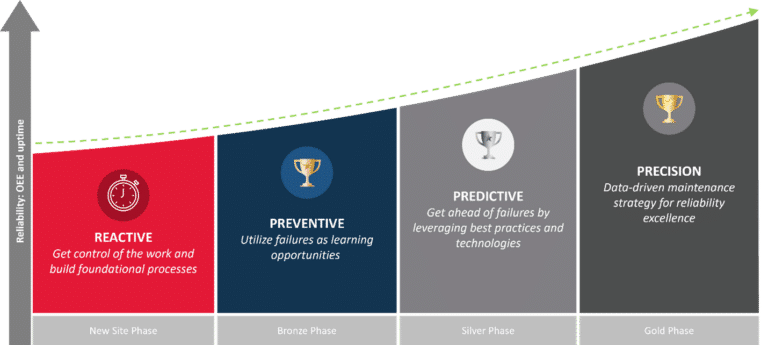
Each type of maintenance is best used in a specific scenario (or scenarios), and nearly all manufacturers will use some combination of the above in the course of their operations (as opposed to just one particular strategy from the list). When used correctly and in the proper context, each of these strategies can lead to reduced unplanned downtime, improved safety and more efficient labor usage. As Industry 4.0 continues to take hold in the manufacturing sector, utilizing these techniques properly becomes even more important. Developing a maintenance strategy is a maturity journey for manufacturers, and learning how to deploy strategies effectively can be more important than having the right tools. Here, we will examine the 4 types of maintenance strategies in greater depth.
Corrective maintenance (or reactive maintenance)
Corrective maintenance, also called reactive maintenance or run-to-failure maintenance, is performed when failure or near-failure is detected and typically addressed immediately or shortly thereafter. As a maintenance strategy, this reactive approach is inefficient and costly, consuming significant resources, spare parts and causing potential downtime because this emergency maintenance only occurs once equipment reaches or approaches a failure state. Relying on it exclusively also introduces safety risks because it means machines are run until their breaking point.
While corrective maintenance should not be an organizational strategy, it is almost always necessary at some point in the course of operations, even with one of the more effective equipment maintenance strategies in place.
Preventive maintenance
Preventive maintenance consists of regularly scheduled maintenance tasks that occur in accordance with OEM recommendations, or at another regular interval as defined by the organization. Examples of planned maintenance tasks include lubrication, replacing belts and calibration. This type of routine maintenance generally occurs whether it is needed or not, and as such, can be inefficient in terms of replacing equipment that is still useful. On the flip side, preventive maintenance is not able to detect more immediate maintenance issues and may result in unplanned downtime. This approach also can lead to cost inefficiencies due to unnecessary work being performed. While preventive maintenance tasks should not be the sole strategy in use, it does provide benefits and should be incorporated into most organizational maintenance plans. This strategy represents an early-stage maintenance maturity and signals that a manufacturer is ready to move up to a more advanced approach.
Predictive maintenance
The difference between preventive and predictive maintenance is that predictive maintenance takes a more proactive approach, drawing on data, analytics and real-time performance metrics delivered by sensors and software to identify impending condition-based maintenance needs and schedule diagnosis and remedy well before unplanned downtime occurs. In contrast to the above two asset maintenance strategies, predictive maintenance is better able to identify the underpinnings of actual problems, enabling technicians to more effectively schedule service at a convenient time. This approach gives proactive maintenance teams the information they need to plan, budget and allocate labor in the most effective manner.
Precision maintenance
Precision maintenance is the next step in the evolution of predictive maintenance, maintaining a laser focus on equipment reliability and uptime. The goal of precision maintenance is to maximize time between failures or maintenance events and minimize downtime (planned or unplanned), resulting in an increase in productivity and efficiency while lowering overall maintenance costs. Whereas predictive maintenance is concerned primarily with when to perform maintenance, precision maintenance is focused on how it should be done. Improving execution excellence is the goal of this approach.
Precision maintenance relies on data, performance analytics and technology such as industrial sensors, and it also incorporates a focus on equipment failure modes, which include complete failure as well operation out of spec. Through the use of Industry 4.0 tools such as condition monitoring sensors and digital torquemeters, teams can ensure proper shaft alignment, torque spec applications and more. By understanding and prioritizing different failure modes and remedies, precision maintenance work can make a tangible difference in your maintenance management efficiency and spend by enhancing the repeatability of tasks and overall asset health.
Bringing it all together: choosing the right maintenance strategy
There’s no universal strategy that applies to all equipment. Instead, it’s important to combine approaches that best fit each piece of equipment. Critical assets are typical best served by predictive or precision maintenance, while non-critical assets can often rely on corrective maintenance. For equipment that doesn’t fall neatly into either category, a preventive maintenance approach may be the most practical option.
ATS provides decades of experience in reliability-centered maintenance solutions and technology, and we are ready to work with you to identify the right mix of people, processes and technology to meet your needs, increase uptime and reduce your costs. With our expertise, we can help you determine where your equipment falls on the maintenance maturity curve so you can identify the maintenance programs that best fit each asset. Contact us to learn more about our industrial maintenance services.