
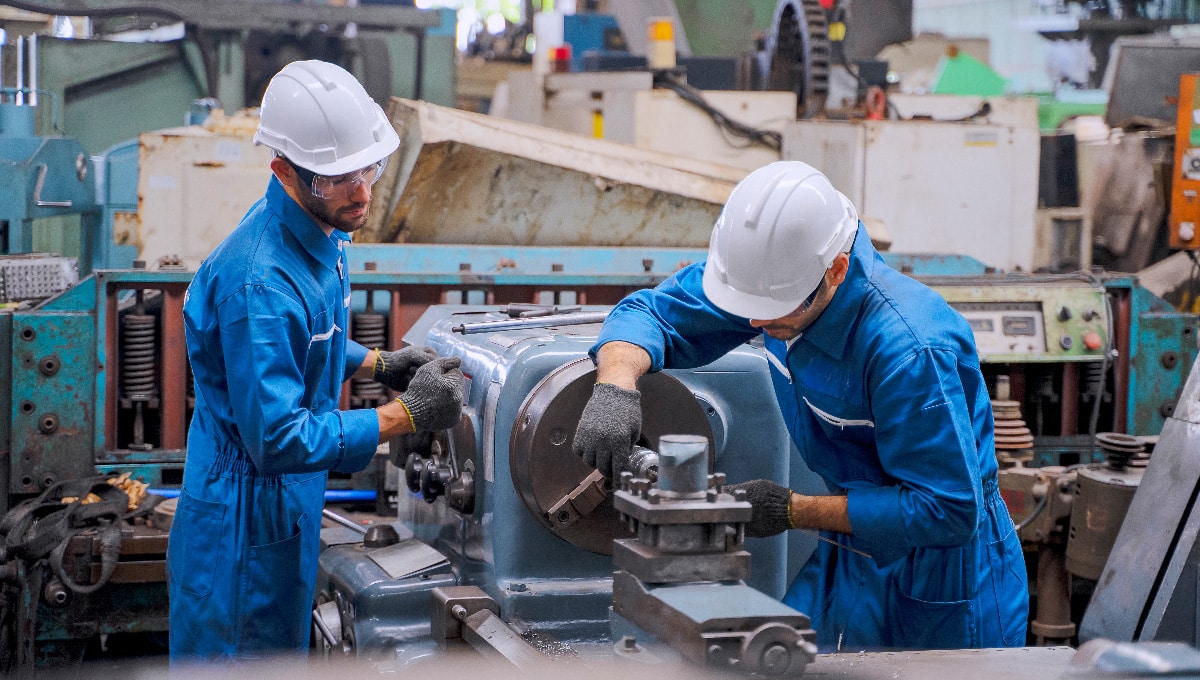




A preventive maintenance (PM) program helps limit machine failures and reduce the risk of unexpected downtime. With companies now losing between 5% and 20% of their average annual productivity to downtime (International Society of Automation, n.d.), PM programs are essential to ensure maximum productivity.
Key components of preventive maintenance include the proactive scheduling of inspections, servicing and repairs.
While this approach requires more time and effort than reactive maintenance—where companies wait for breakdowns and respond only after the fact—it offers substantial benefits for manufacturers. For example, repairing parts before they fail helps reduce overall downtime, and replacing key components on a regular schedule helps extend equipment lifespan. Well-maintained machines are also less expensive to maintain and help improve overall staff safety.
But what does it take to build an effective PM program? In this piece, we’ll provide a step-by-step guide to help get your preventive maintenance efforts implemented quickly and ensure they deliver consistent value over time.
Step 1 — Assess your current maintenance practices
Before you can build a new preventive maintenance program, you need to assess current practices by documenting and reviewing your existing strategy.
This provides two benefits. First, it pinpoints where maintenance programs are working. Second, it identifies gaps in your process. Equipped with this information, you’re better prepared to build and invest in a PM program that targets problem areas.
Assessments start with a simple question: Is your plant reactive-heavy or partially reactive? This lays the groundwork for your PM plan and helps ensure you don’t overspend in areas that don’t need improvement.
To answer this question, you need data. Start with documentation that tracks breakdown frequencies, average downtime costs, spare parts management and broader MRO asset management practices. Next, speak to technicians and operators about common pain points—what maintenance issues take up most of their time? What parts fail most often? Why?
Finally, use solutions such as computerized maintenance management systems (CMMS) to review failure log histories and identify trends. In combination, this data provides a big picture view of your current maintenance operations. If more than half of the machines on your production line have experienced sudden failure and downtime, your maintenance strategy is primarily reactive.
Step 2 — Build an equipment inventory and prioritize assets
The next step is building an equipment inventory and prioritizing your critical assets.
Begin by compiling a comprehensive equipment inventory list, including make, model, age, and operating conditions. Make sure this list is digitized and accessible to both maintenance staff and management.
This provides the basis for prioritization. Here, the goal is to categorize your assets based on criticality using three factors: Production impact, safety risk and compliance. Consider a product packaging machine. If all production lines lead to this machine, its potential failure creates a massive bottleneck, making it a high-priority asset. The same is true of any machine that operates using high temperature or pressure; failure comes with significant safety risks.
Once assets are categorized, you can prioritize them based on risk. The more vital machines are to uptime, safety and compliance, the more often they should be assessed, evaluated and repaired.
Step 3 — Define preventive maintenance tasks
With assets identified, you need to define preventive maintenance tasks and determine maintenance intervals.
Common tasks include:
- Visual inspections
- Parts replacement
- Full machine cleaning
When it comes to intervals, meanwhile, there are several factors to consider. First are the original equipment manufacturer (OEM) recommendations. For example, OEM specifications might mandate a specific timeframe for component evaluation, repair or replacement.
But these recommendations only tell part of the story. Current production demands paired with environmental conditions can potentially reduce machine lifespans or require more frequent evaluations. One example is shops that require high-pressure and high-temperature equipment. These conditions impact the overall environment and may cause components to wear out more quickly. Historical failure data can help businesses better visualize failure patterns to determine optimal maintenance intervals.
It’s also important to speak with technicians about their experience with production line machines and the pain points they’ve encountered. In many cases, these pain points don’t result in downtime or even production slowdowns, in large part because on-floor technicians have found workarounds and alternatives. By incorporating their first-hand experience, maintenance managers are better equipped to determine the ideal type and frequency of maintenance tasks.
Step 4 — Establish a preventive maintenance schedule
Scheduling comes next. It’s not enough to know when and how machines need maintenance. To reduce the risk of downtime, companies need clear schedules that specify when, how and why actions should be taken.
Manufacturers also need to balance productivity and maintenance. If maintenance occurs too frequently on critical assets, it can negatively impact overall throughput. If maintenance isn’t happening often enough, productivity suffers at the hands of unexpected downtime.
Four best practices can help establish solid schedules:
- Create recurring frameworks: Divide up tasks based on how often they should be completed. The result should be a schedule that lists out daily, weekly, monthly and annual tasks. While this schedule isn’t unchangeable, codifying it helps ensure that tasks aren’t missed.
- Align with planned downtime windows: Whenever possible, maintenance schedules should align with planned downtime windows. These windows may occur due to equipment upgrades, plant-wide cleaning or company-wide inspections. These downtime windows are a good time to carry out more labor-intensive maintenance tasks, such as those that occur once every quarter or year.
- Use CMMS software to automate task scheduling: CMMS software helps automate tasks and maintenance scheduling by providing notifications to staff when maintenance activities are upcoming, due or overdue. In addition, staff can mark tasks as completed so they aren’t accidentally duplicated.
- Build in flexibility for urgent issues: Despite best efforts, machines may still fail unexpectedly. Schedule flexibility provides room for staff to address and resolve these issues promptly. In practice, flexibility can take the form of redundant processes or machines that can temporarily handle production loads while primary assets are repaired.
Flexibility also requires companies to ensure they have replacement parts and skilled staff. If parts need to be ordered and shipped, or if staff lack the hands-on knowledge to identify and address root causes, companies may lose significant time and money.
Step 5 — Assign responsibilities and staff
PM programs depend on people. Parts don’t replace themselves, and notifications aren’t effective if there’s no one around to carry out maintenance schedules. As a result, companies must take the time to assign roles, determine responsibilities and train staff.
First up is training. All staff should be given basic training in how to conduct regular PM tasks and report issues using CMMS or other maintenance solutions. Companies should then assign specific roles, including technicians, supervisors and operators, each with its own set of responsibilities and expectations. This helps reduce task overlap while ensuring that all key tasks are completed.
It’s also important to identify a C-suite or senior management member as the owner of PM processes. This allows them to champion the initiative and provide necessary support to maintenance staff. Ownership of schedules and tasks then cascades down the chain from supervisors to technicians and operators. By ensuring that each role is accountable for specific tasks and reporting, manufacturers can gain improved visibility into PM processes.
Finally, it’s worthwhile to encourage cross-training where possible. This helps bridge the gap if skilled staff are absent, retire or leave the company. Retraining and reskilling can be costly and time-consuming, but cross-training provides a safeguard against workforce shortages by ensuring broader operational coverage.
Step 6 — Track performance and adjust the program
Metrics matter. These maintenance KPIs indicate if programs are working as intended and set the stage for program improvement over time.
Key metrics to measure include:
- Mean time between failures (MTBF): The higher this value, the better, since it means that failures occur less frequently.
- Mean time to repair (MTTR): The lower this value, the better, since it means technicians can repair machines more quickly.
- Planned vs. unplanned maintenance ratio: Ideally, you want more planned than unplanned maintenance to help reduce costs and improve performance.
- Overall downtime costs: Track this data over time to determine if costs are going up, staying the same or falling. If they are increasing, it’s time to reevaluate your PM plan.
Reviewing this data allows maintenance teams to improve PM performance. For example, technician reports and feedback can help determine if task scheduling is accurate. Consider a group of technicians responsible for weekly component lubrication of a critical production line machine. If these technicians report that lubrication levels are always well within tolerance when they carry out this task, it may be worth switching to bi-weekly maintenance.
In combination with performance data tracked over time, companies can continuously adjust intervals and tasks to deliver optimal production throughput without increasing failure rates.
It’s also important to leverage a predictive maintenance strategy in conjunction with your preventive maintenance plan. Predictive tools such as connected sensors and IoT devices help evolve programs over time. Sensors can report on conditions such as temperature, pressure and vibration in real-time. If connected to a larger Industrial Internet of Things (IIoT), this sensor data can be used to flag problems in their earliest stages. Collecting and analyzing this data over time lets companies make targeted adjustments to PM programs.
Common pitfalls to avoid
Like any new program or process, a preventive maintenance strategy comes with potential pitfalls. Knowing and avoiding these issues is critical to ensure PM programs pay dividends.
Here are some of the most common PM pitfalls:
- Overloading technicians with too many tasks: If technicians have too many tasks for too many machines, something has to give. Tasks may be incomplete or skipped altogether, which puts companies at risk of machine failure. Avoid this problem by ensuring you have enough staff on hand or outsourcing less technical tasks to managed service providers.
- Failing to prioritize critical assets: Not every asset has the same value. For example, if you have four assembly stations for a product but only one piece of finishing machinery, this single asset becomes a bottleneck if it fails. If all assets are treated equally, you may over-commit resources to machines that can afford to (briefly) fail and under-commit resources to mission-critical assets. To avoid this imbalance, conduct an in-depth assessment before creating a PM plan.
- Focusing on speed over standardization: The less time spent carrying out repairs, the better, so long as processes are standardized and fully documented. Failure to do so can lead to inconsistencies in how machines are evaluated, repaired and tested, which can lead to unexpected downtime.
Here, the solution lies in documentation before action. Ensure that all processes are clearly documented and include a preventive maintenance checklist.
- Skipping training and communication: Effective preventive maintenance requires ongoing training and consistent communication. Failure to educate staff on new processes or leaving them out of the loop when assets change or are retired, can lead to a disconnect between maintenance activity and outcomes. In the best-case scenario, you lose time. In the worst case, you lose time, money and resources.
Take a pass on this problem by creating a regular training schedule and building a maintenance database that technicians can refer to (and add to) as needed.
- Treating PM as static: Preventive maintenance plans evolve as machinery ages, production demands fluctuate and environmental conditions change. If companies treat PM programs as static, they will quickly find themselves falling behind and at risk of machine failure.
Keep PM up to date by setting up regular review sessions that analyze current and historic data to pinpoint possible trends and inform new processes.
Get support for your preventive maintenance program
Preventive maintenance programs help reduce downtime, save money and improve machine reliability. Building these programs, however, requires a combination of the right tools, the right people and the right approach.
While manufacturers can take on the task of creating, implementing and managing their PM programs over time, it’s often more cost and resource-effective to partner with experienced outsourced maintenance experts to help streamline the process.
ATS provides both skilled technicians and proven preventive maintenance services to help improve uptime, reduce costs and extend equipment life. We offer a range of options, including short-term support, long-term partnerships and fully managed maintenance programs. From service to strategy, we can deliver customized maintenance programs that reduce your downtime risk and improve production performance.
Make the most of your preventive maintenance program with ATS. Let’s talk.
References
Crumrine, D., & Post, D. (n.d.). How much is plant or facility downtime costing you? ISA. https://blog.isa.org/downtime-factory-plant-industrial-costs-risks