




Spending on the Industrial Internet of Things (IIoT) surpassed $142 billion in 2025 and is on track to add another $50 billion through 2026.
At its most basic, the Internet of Things is a network of connected sensors and devices, which enables industrial and manufacturing organizations to capture, monitor and manage operational conditions in real-time.
IoT deployments are also a key driver of predictive maintenance strategies. If companies can detect faults early and predict when failures will occur, they can act before those failures stop production. This can improve performance and reduce reliance on reactive and time-based approaches.
According to research published in the International Journal for Modern Trends in Science and Technology, “experimental results indicate that IoT-based predictive maintenance significantly improves reliability and asset longevity compared to traditional maintenance approaches.”
The challenge? Designing and deploying strategies for IoT in predictive maintenance that deliver on proactive potential without breaking the bank. Here’s what manufacturers need to know about making the move.
How IoT predictive maintenance works
IoT predictive maintenance depends on communication. Devices and sensors must effectively communicate with equipment and each other to provide consistent streams of data. In addition, these sensors and devices must be properly calibrated to provide accurate and timely outputs.
Consider a piece of critical production line equipment that is experiencing more downtime, more often. IoT sensors can track behaviors and conditions that lead to this downtime, but only if they can quickly and easily collect data from physical infrastructure and programmable logic controllers (PLCs) and report this data accurately to solutions such as computerized maintenance management systems (CMMS), manufacturing execution systems (MES) and enterprise resource planning (ERP) tools.
There are six basic steps in any IoT-enabled predictive maintenance process.
Step 1: Sensors collect equipment data
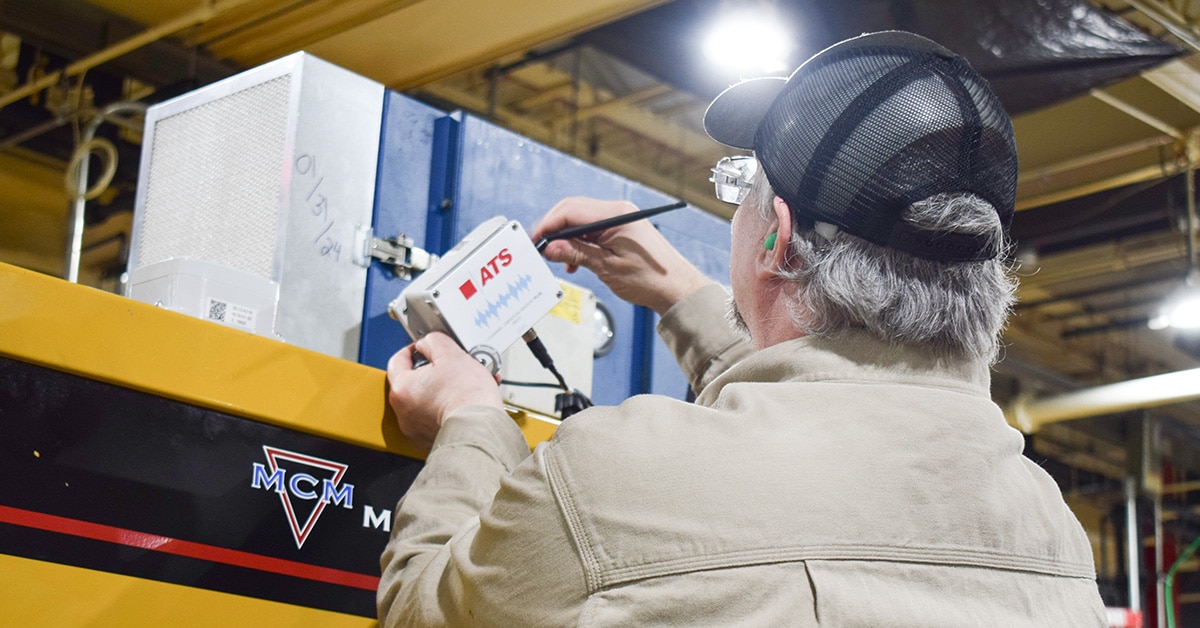
Connected sensors collect data directly from equipment. These sensors may be placed directly onto machinery or embedded within other components. Sensors can be calibrated to collect all incoming data or only do so when data values reach or fall below a specific threshold.
For example, a vibration sensor might provide a continuous picture of vibration speed and intensity, or it may only be triggered when vibrations fall outside expected values.
Step 2: Data is transmitted via an IoT network
Once data is collected, it is transmitted using an IoT network. This network may be wired, wireless or some combination of both. Regardless of how it operates, however, what matters most is reliability. Networks must consistently capture and deliver data without packet loss or degradation to ensure complete visibility.
Step 3: Data is stored in a centralized platform
Data must also be stored in a secure, centralized platform for in-depth analysis and use. As noted above, these platforms often include CMMS, MES and ERP systems.
Companies may also choose to store IoT data across multiple platforms. This both provides data redundancy and enables multiple teams to use data simultaneously. For example, finance teams might access ERP solutions to plan for future CapEx spending and OpEx maintenance costs, while production floor managers might use CMMS platforms to identify performance bottlenecks.
Step 4: Analytics identify anomalies and trends
Next is the analysis of data to identify anomalies and trends and then act on these outputs to address problems before downtime occurs.
If sensors show a slow but consistent temperature increase across assembly line machinery, this may necessitate planned downtime to identify and resolve the issue. If IoT networks indicate periodic spikes in temperature that are well outside baseline readings, it’s worth conducting a complete root cause failure analysis (RCFA) to find the underlying cause.
Step 5: Alerts are triggered for potential failures
If sensor data indicates the chance of a potential failure, such as a power loss or damage due to excess vibration, this triggers an alert. When connected to predictive maintenance tools and platforms, these alerts enable teams to take quick and targeted action.
Step 6: Maintenance is proactively scheduled
Equipped with sensor data, teams can proactively schedule maintenance to reduce the risk of unexpected failures. For example, if analysis indicates declining equipment performance over time, maintenance managers can schedule monthly or bi-weekly inspections to verify that seals are intact, gaskets are undamaged and parts are properly lubricated.
Key IoT technologies used in predictive maintenance
Multiple IoT technologies work in tandem to improve predictive maintenance.
- Sensors: Common types include vibration, temperature, current, pressure, and sound.
- Edge devices: These IoT devices may include data collectors or relays that improve the speed and accuracy of sensor reporting and enable real-time alerts.
- Cloud platforms: Cloud platforms provide centralized storage platforms that can be scaled on demand.
- AI/ML analytics: Artificial intelligence (AI) and machine learning (ML) analytics support advanced pattern detection that enhances failure prediction.
- CMMS solutions: Deploying and integrating CMMS tools helps support work execution strategies by providing a single source of truth for maintenance planning.
Technology | Function | Best use case |
Sensors | Data collection | Equipment monitoring |
Edge devices | Local processing | Real-time alerts |
Cloud platforms | Data storage | Scalability |
AI/ML | Pattern detection | Failure prediction |
CMMS | Work execution | Maintenance planning |
Looking to implement IoT for better equipment reliability? See what’s recommended for your facility.
What equipment should utilize IoT monitoring?
IoT monitoring can benefit most equipment, but deploying connected sensors across all manufacturing machinery often isn’t cost-effective. Equipment types that offer the best return on IoT investments include:
- High-value assets
- Critical production equipment
- Rotating machinery
- Equipment with frequent failures
With a host of potential options for IoT integration, what are your best starting points for IoT monitoring? First is equipment that creates a significant production impact if unplanned downtime occurs. For example, if your production line has five pieces of equipment for component assembly but only one piece of packaging machinery, the bottleneck created by packaging equipment downtime makes it a top priority for IoT monitoring.
Next are pieces of equipment that have higher failure risks based on machine health assessments. These may include machines that operate under high temperature or pressure for long periods and are prone to component failure.
Machines with multiple redundancies and those that are near the end of their remaining useful life (RUL), meanwhile, can often be effectively maintained using time-based preventive maintenance.
How ATS supports IoT-driven predictive maintenance
IoT-driven predictive maintenance depends on the interplay of multiple systems, sensors and networks. This can create challenges for maintenance teams that already have their hands full with existing production line operations. ATS provides multiple support pathways for IoT-based predictive maintenance.
This starts with sensor deployment and monitoring. ATS experts can help teams select the right mix of sensors and remote monitoring tools for their production environment, and ensure that new industrial technologies are effectively integrated with existing SCADA, ICS and other proprietary solutions.
ATS also delivers in-depth predictive analytics and insights to help companies identify root causes and take targeted action. These actions may include the development of reliability optimization strategies, the creation of maintenance execution plans and the deployment of skilled professionals to integrate and manage industrial IoT technologies.
IoT implementation checklist for predictive maintenance
If you’re considering a shift to IoT-enabled predictive maintenance, planning is critical. Use this IoT implementation checklist to plan the rollout. Identify critical assets.
1. Select appropriate sensors.
2. Install IoT infrastructure.
3. Integrate with CMMS.
4. Establish data baselines.
5. Set alert thresholds.
6. Train maintenance teams.
7. Continuously optimize.
Not sure how to implement IoT in your facility? Talk to an expert about building a predictive maintenance program.
Take the next step toward IoT-driven maintenance
IoT-driven maintenance depends on sensor and device technologies backed by reliable network connections.
Technology alone, however, isn’t sufficient for predictive maintenance success. In practice, organizations need a combination of strategy, staffing and support for IoT deployments.
The outcome is worth the effort. When effectively integrated with existing maintenance strategies, IoT-driven approaches deliver predictive insights that help enhance operational efficiency and improve equipment uptime.
Make the most of maintenance resources with an IoT-driven approach. See how ATS can help.
References
Mordor Intelligence. (2026, September 11). Industrial Internet of Things (IIoT) market size & share analysis: Growth trends and forecast (2026–2031). Retrieved October 6, 2026, from https://www.mordorintelligence.com/industry-reports/industrial-internet-of-things-iiot-market
Singh, H. (2025). IoT based predictive maintenance in industrial machinery. International Journal for Modern Trends in Science and Technology. https://www.researchgate.net/publication/393468255_IoT_Based_Predictive_Maintenance_in_Industrial_Machinery
