
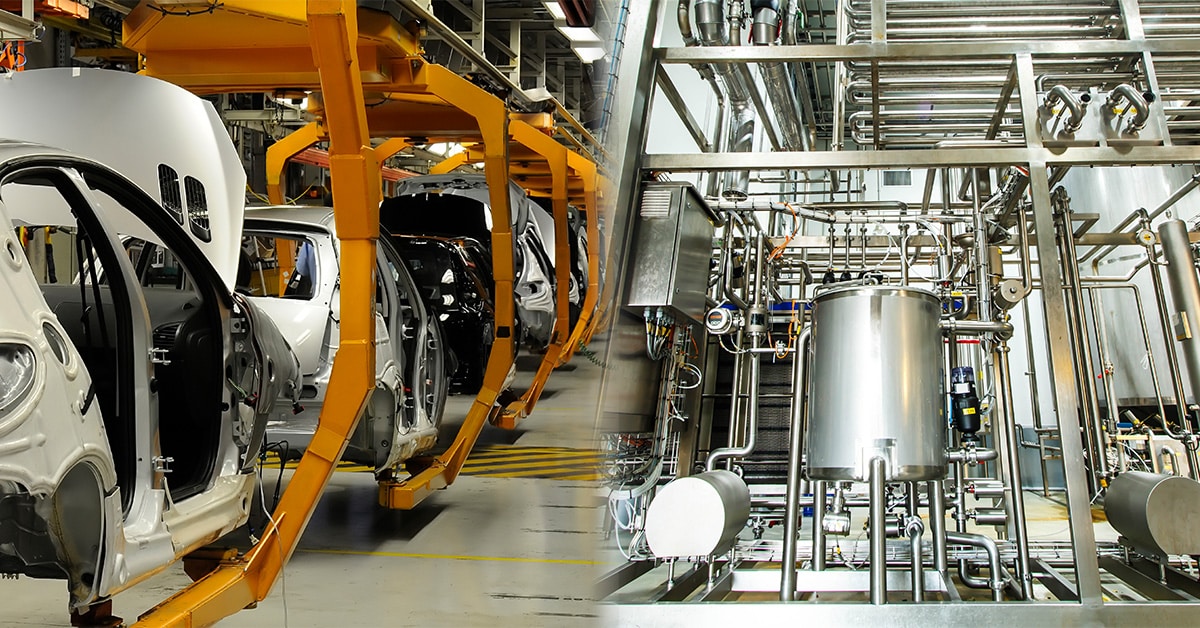




Discrete manufacturing involves creating products by assembling individual, tangible parts. These parts are assembled in a specific sequence to produce the desired result. The production lines in discrete manufacturing produce products that are similar but not identical. Since each step in the discrete manufacturing process is distinct from those before and after it, this approach is often used to create complex, multipart components and products. Discrete manufacturing industry examples include automotive, aerospace, electronics, and consumer goods.
Process manufacturing involves combining multiple materials or ingredients to produce a final product that cannot be separated back to its original components. In process manufacturing, formulas or recipes specify the quantity and type of materials required and provide step-by-step instructions for combining these materials. If instructions are not followed in order, the end result will be incorrect. Process manufacturing industry examples include chemicals, pharmaceutical, oil and gas, and food and beverage producers.
Discrete vs process manufacturing matters as each model has different needs for production scheduling, quality control, inventory management, maintenance planning, and equipment monitoring.
Which maintenance approach works best for your organization will depend on whether your operation relies on assembly sequencing, continuous flow, batch consistency, or asset criticality. Read on for Advanced Technology Services (ATS) recommended approaches and industry best practices.
Discrete manufacturing overview
Discrete manufacturing is the production of distinct, physical, countable products that are made from separate parts and components. The parts are connected but not blended. This means products can be disassembled and potentially reused. Finished products can often be counted, inspected individually, disassembled, repaired, or reconfigured. Discrete manufacturers, such as automobile or aerospace companies, take nuts, bolts, wheels, engines, and windows and put them together to form an entirely new and final product.
Process manufacturing overview
Process manufacturing is the production of goods by mixing, blending, reacting, heating, separating, or otherwise transforming raw materials. Finished products are often measured by volume, weight, batch, or formula rather than individual units. Products generally cannot be disassembled back into original ingredients.
Process manufacturers, such as pharmaceutical companies and food and beverage manufacturers, take raw ingredients, blend and mix them together, and create a new product that can no longer be separated.
Discrete vs. process manufacturing: Key differences
Discrete manufacturing produces distinct, countable products through assembly-based production, while process manufacturing uses formulas and recipes to blend or mix raw materials in batches or through continuous flow into new products that cannot be separated. These two processes can be viewed as batch vs continuous production.
Category | Predictive maintenance | Preventive maintenance |
Ouput | Distinct, countable products | Blended, batch, or continuous products |
Inputs | Parts and components | Ingredients, chemicals, or raw materials |
Production method | Assembly-based | Formula, batch, or flow-based |
Reversibility | Products may be disassembled | Products usually cannot be separated back into inputs |
Tracking | Serial numbers, parts, work orders | Batches, lots, formulas, process conditions |
Examples | Cars, electronics, appliances | Food, chemicals, pharmaceuticals |
Maintenance risk | Line stoppages disrupt assembly flow | Process interruptions can affect entire batches |
Quality focus | Fit, tolerance, assembly accuracy | Consistency, purity, formulation, process conditions |
Production planning differences
Production planning differs between discrete and process manufacturing. Discrete manufacturing focuses on assembling distinct units using a bill of materials, routing, work orders, production schedules, and assembly sequencing. It focuses on part availability, labor coordination, workstation flow, and product configuration.
Process manufacturing uses formulas, recipes, batch records, process parameters, and lot tracking to manage continuous, batch-based, non-reversible products. It focuses on material consistency, batch timing, process control, manufacturing recordkeeping, and regulatory documentation.
Maintenance needs in discrete vs. process manufacturing
Discrete manufacturing maintenance focuses on robotics, conveyor belts, and assembly lines using preventive and predictive maintenance. Process manufacturing maintenance focuses on pumps, mixers and valves using a preventive maintenance program.
Maintenance factor | Discrete manufacturing | Process manufacturing |
Common assets | Computer numerical control, robotics, conveyors, presses | Pumps, mixers, tanks, valves, boilers |
Downtime impact | Stops assembly flow or production cells | Can affect batch quality or continuous output |
Common maintenance focus | Precision, alignment, motion systems | Process stability, contamination control, flow control |
Recommended strategies | Preventive maintenance, predictive maintenance, operator care, spare parts planning | Preventive maintenance, calibration, process monitoring, compliance checks |
Key risks | Bottlenecks, defects, missed schedules | Batch loss, safety risk, regulatory noncompliance |
Predictive maintenance is recommended for high-value assets where failure would stop production or compromise product quality. Preventive maintenance may be sufficient for assets with predictable wear patterns. Condition monitoring of equipment works especially well where failure signals can be detected through vibration, temperature, pressure, flow, or current.
Are you looking to align your maintenance strategy with your production model? ATS is a comprehensive maintenance provider giving clients a single source for reliability-based maintenance programs, technology-assisted insights, and standardized workflows. Our approach is designed to reduce machine downtime and improve operational efficiency. See what’s recommended for your facility. Talk with an ATS expert.
Quality control differences
Quality control in discrete manufacturing focuses on inspecting distinct, countable units at specific assembly stages for easy rejection or repair. Individual units are examined for dimensions, fit, finish, and assembly accuracy. Equipment that is not correctly maintained may cause product tolerance standards issues, repeat defects, poor fastening, and surface finish issues that lead to rework and scrap.
Process manufacturing quality control involves inspecting batches or continuous flows by sample testing, as the product is often irreversible and cannot be disassembled. This can include monitoring formulas, process and manufacturing conditions, purity, consistency, viscosity, and batch quality. Equipment that is not functioning correctly may cause off-spec batches, contamination risk, incorrect temperature or pressure conditions, and inconsistent mixing or flow.
Inventory and MRO differences
Inventory and maintenance, repair, and operations (MRO) needs to differ between discrete and process manufacturing as these are two different systems. Inventory needs for discrete manufacturing include component parts, subassemblies, tooling, fasteners, spare parts, and components for robotics, conveyors, computer numerical controls (CNCs), and assembly equipment. Process manufacturing has inventory needs for raw materials, ingredients, chemicals, filters, seals, pumps, valves, instrumentation spares, calibration tools, and testing supplies. Discrete manufacturers use MRO strategies that focus on preventive maintenance, predictive maintenance, operator care, and spare parts planning, while process manufacturers use MRO methods that use preventive maintenance, calibration, process monitoring, and compliance checks.
Which MRO strategy works best for your organization will depend on your facility’s particular asset criticality, supplier lead times, downtime cost, and quality risk. If you are looking for a partner in MRO asset management and services, ATS can help. We offer data-driven MRO solutions designed to support equipment reliability and effectiveness. Talk with an ATS expert today.
How to choose the right maintenance strategy for your manufacturing type
Which maintenance strategy works best for your organization will depend on several factors such as equipment type, production flow, failure consequences, safety and compliance requirements, cost of downtime, and your team’s capabilities. A recommended best practice to follow, regardless of your organization using discrete or process manufacturing, is to always have critical spare parts on hand for equipment breakdowns. These critical components should always be prioritized for assets that can create production bottlenecks or compliance risks.
Discrete manufacturing strategy
- Preventive maintenance for routine equipment care
- Predictive maintenance on production bottlenecks
- Operator care for daily inspections
- Spare parts strategy for high-wear components
- Computerized maintenance management system (CMMS) for work order management
Process manufacturing strategy
- Predictive maintenance for pumps, motors, and process-critical assets
- Calibration programs for instrumentation
- Environmental and condition monitoring
- Strong compliance documentation
- Process control system maintenance
How ATS supports discrete and process manufacturing operations
Discrete and process manufacturing require different production controls, quality processes, and maintenance priorities. The right strategy depends on asset criticality, production flow, failure risk, and compliance needs. Manufacturers should assess how equipment, production models and maintenance programs work together.
ATS helps manufacturers improve uptime, reliability, and maintenance execution across both discrete and process environments. We are your partner, providing maintenance strategies that are adapted to your facility’s specific production model, asset base and operational risks. We evaluate your production model, identify your highest-risk assets, and align your maintenance strategy with the way your facility actually operates. Talk with an ATS expert.
